How to Assess Protocol Insolvency Risk in DeFi
By Jorge Rodriguez — Risk Management
A six-step framework for evaluating protocol solvency before you deposit
On-chain signals and dashboards that reveal insolvency risk early
Real case studies of protocols that accumulated fatal bad debt
Introduction
When a DeFi protocol accumulates more liabilities than assets it can cover, depositors are the ones left holding the bag. There is no FDIC insurance and no bankruptcy court. The protocol is simply insolvent, and your deposits may be partially or fully unrecoverable. **DeFi protocol insolvency risk** is one of the most consequential and undermonitored threats in decentralized finance. Unlike exploits, which happen in seconds, insolvency builds gradually through failed liquidations, bad debt accumulation, and treasury depletion. The warning signs are often visible on-chain well before the situation becomes critical. This guide gives you a practical framework for assessing insolvency risk before you deposit, covering the mechanics of how protocols become insolvent, the on-chain signals to watch, and the tools to monitor ongoing solvency. Whether you are evaluating a lending market on Ethereum, a yield vault on Solana, or a CDP protocol on Base, the same structural risks apply. For a broader look at the risk landscape that can lead to protocol-level failures, see [DeFi yield risks explained](/blog/risk-management/defi-yield-risks-explained). 
What Protocol Insolvency Actually Means in DeFi
**Protocol insolvency** occurs when the total value a protocol owes to depositors exceeds the total value of assets it controls. Those assets include collateral held against loans, reserve funds, and treasury holdings. When the math stops adding up, depositors face losses. This can be partial or systemic. A partial shortfall means specific markets within a protocol have accumulated debt that exceeds their collateral backing. Systemic insolvency means the protocol as a whole cannot cover its obligations, even after deploying its entire treasury and safety reserves. **How Insolvency Differs from an Exploit** Exploits are sudden events. A flash loan attack, reentrancy bug, or access control failure drains funds in a single transaction. Insolvency, by contrast, can build over weeks or months through gradual bad debt accumulation, failed liquidations, or slow collateral depreciation. Both can coexist, but they require entirely different detection methods. **The Spectrum from Bad Debt to Full Insolvency** Not every instance of **bad debt** means a protocol is insolvent. The progression typically follows a pattern: a single borrowing position goes underwater when its collateral value drops below the debt value. If liquidators fail to act, this creates bad debt. When bad debt accumulates across multiple markets and the protocol's treasury cannot cover the shortfall, the protocol moves toward insolvency. A protocol with $500,000 in bad debt and a $10 million treasury is not insolvent. A protocol with $15 million in bad debt and a $10 million treasury is. The ratio between bad debt and available reserves is what matters, not the absolute numbers.
How DeFi Protocols Become Insolvent
Understanding the root causes helps you spot them before they escalate. Five primary mechanisms drive protocol insolvency. 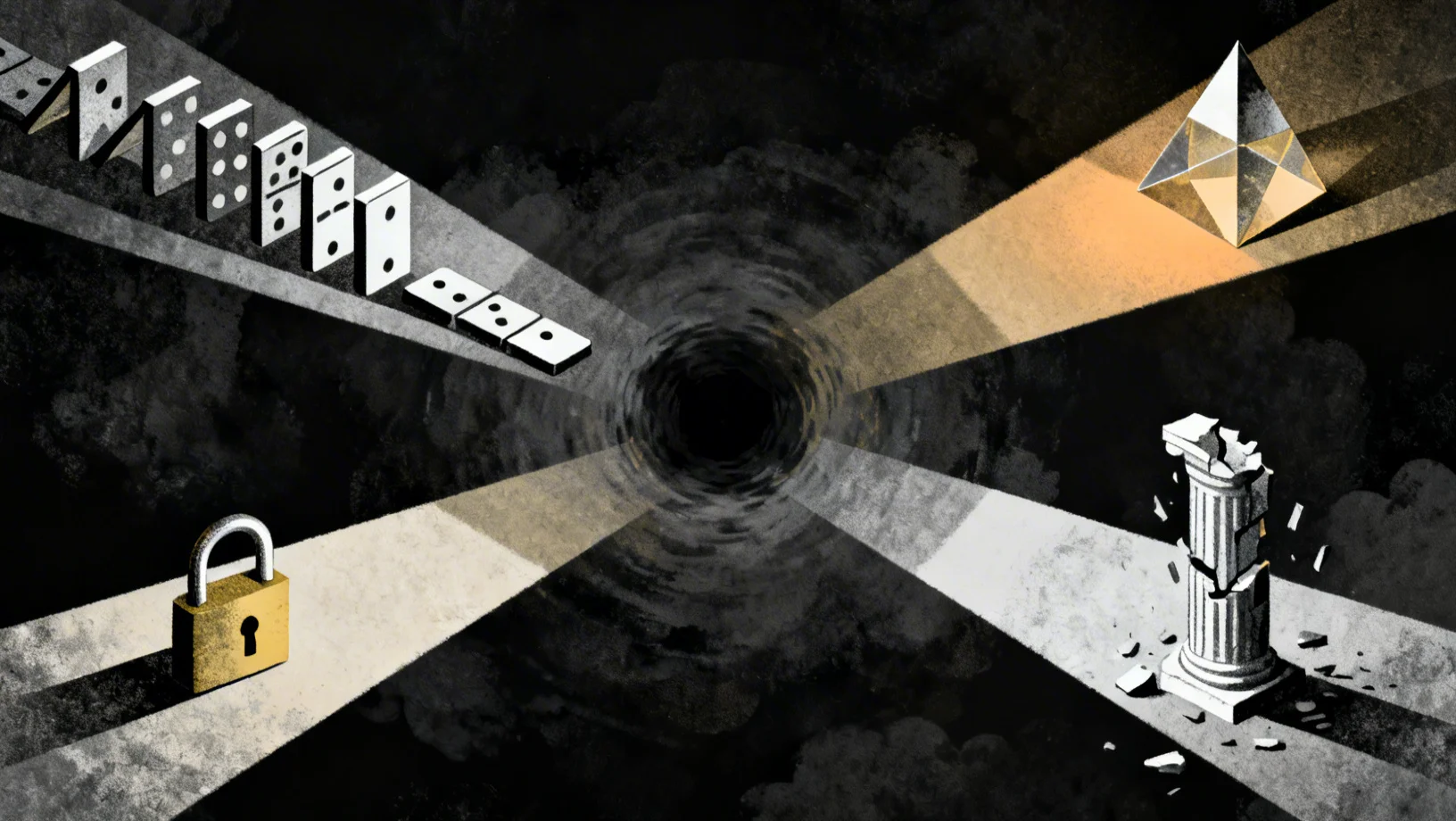 **Failed or Delayed Liquidations** Lending protocols rely on liquidators to close underwater positions before bad debt forms. When collateral value drops too fast for liquidators to act profitably, or when the **liquidation bonus** does not cover gas costs and price slippage, nobody liquidates. The protocol absorbs the loss. During extreme volatility, dozens or hundreds of positions can go underwater simultaneously, creating a **liquidation cascade** that overwhelms the system. For a detailed look at how liquidation mechanics vary across ecosystems, see [how DeFi liquidations work on Solana](/blog/risk-management/defi-liquidations-solana). **Oracle Failures and Price Manipulation** An **oracle** provides external price data to smart contracts for collateral valuation. Stale oracle prices, manipulation through thin-liquidity markets, or oracle lag during high volatility can make collateral ratios fictional. If a protocol values collateral at $10 when the market price is $6, positions that appear healthy are actually underwater. The Mango Markets exploit in 2022 demonstrated how oracle price manipulation can drain an entire protocol. For deeper coverage of how oracle infrastructure affects depositor safety, see [oracle prices and DeFi risk](/blog/risk-management/oracle-prices-defi-risk). **Toxic Collateral and Illiquid Assets** Accepting low-liquidity tokens as collateral creates hidden insolvency risk. Even if the loan-to-value ratio looks safe on paper, a large liquidation can crash the token's price, making the collateral worth far less than the protocol assumed. The result is bad debt that no liquidator will touch. **Contagion from Interconnected Protocols** DeFi's composability means protocols are deeply interconnected. Protocol A might accept LP tokens from Protocol B as collateral. If Protocol B suffers an exploit, Protocol A's collateral becomes worthless overnight. This **contagion risk** is difficult to assess because it requires mapping dependencies across multiple protocol layers. **Governance Failures and Parameter Misconfigurations** Aggressive risk parameters set by governance without adequate safety nets can create the conditions for insolvency. High loan-to-value ratios, low liquidation penalties, and accepting risky collateral without **borrow caps** or **isolated markets** leave protocols exposed. Scream on Fantom accepted stale-priced stablecoins as collateral and accumulated $35 million in bad debt as a direct result of parameter misconfiguration.
The Insolvency Assessment Framework
This six-step framework gives you a structured approach to evaluating any protocol's solvency position. Use it before depositing and as an ongoing monitoring tool. For a complementary evaluation that covers broader due diligence beyond solvency, see the [DeFi due diligence checklist](/blog/risk-management/defi-due-diligence-checklist).  **Step 1: Check the Protocol's Bad Debt Position** Bad debt is the most direct indicator of solvency health. Look for positions where debt exceeds collateral value across the protocol's markets. Many protocols surface this data on their own risk dashboards. For those that do not, community-built Dune Analytics dashboards track bad debt for major lending protocols like Aave and Compound. The critical metric is the ratio of bad debt to total TVL. A protocol with $200,000 in bad debt on $2 billion in TVL has a 0.01% bad debt ratio, which is healthy. A protocol with $50 million in bad debt on $300 million TVL has a 16.7% ratio, which signals serious stress. Track this ratio over time. If it is growing, the protocol is trending in the wrong direction. **Step 2: Analyze Treasury Composition and Reserves** A protocol's treasury is its buffer against losses. What matters is not just the size but the composition. **Treasury reserves** dominated by the protocol's own governance token create a circular dependency. If the protocol faces stress, the token price drops, which reduces the treasury's effective value precisely when it is needed most. Healthy treasuries hold diversified stablecoin reserves and externally backed assets. Check treasury holdings on DefiLlama's treasury tracker or the protocol's own governance dashboard. A treasury that is 90% native token provides far less real protection than one that is 60% stablecoins and 20% ETH. **Step 3: Evaluate the Safety Module or Insurance Mechanism** Does the protocol have a **safety module**? Aave's staked AAVE backstop is the most well-known example. Stakers lock governance tokens that can be slashed to cover a **shortfall event**. The key questions are: how much coverage does the module provide relative to total deposits? What triggers a shortfall event? What is the claims process? A safety module covering 2% of total deposits provides limited protection against systemic bad debt. Compare the module's total staked value to the protocol's total liabilities. For a full breakdown of how DeFi insurance mechanisms work, see [DeFi insurance protocol coverage](/blog/risk-management/defi-insurance-protocol-coverage). **Step 4: Review Collateral Parameters and Liquidation Design** The protocol's risk parameters determine how resilient it is to market stress. Key numbers to check: • Loan-to-value (LTV) ratios for each collateral type • Liquidation thresholds and **liquidation bonus** percentages • **Borrow caps** and supply caps for individual assets • Whether **isolated markets** are used for riskier assets • How the protocol handles cascade liquidations Protocols that accept a wide range of collateral types without isolated markets or borrow caps are structurally more vulnerable to insolvency than those with conservative, tiered risk parameters. **Step 5: Monitor Oracle Infrastructure** Oracle quality directly affects collateral valuations. Check which oracle provider the protocol uses, whether there is a fallback oracle, the update frequency, and whether circuit breakers exist for extreme price deviations. Assets priced through thin on-chain liquidity pools are especially vulnerable to manipulation. A protocol using Chainlink price feeds with a Uniswap TWAP fallback and a circuit breaker for deviations above 10% is meaningfully safer than one relying on a single on-chain price source with no failsafe. **Step 6: Assess Governance and Risk Management Track Record** How has governance responded to past risk events? Has the protocol ever accumulated bad debt, and if so, what actions were taken? Protocols with active risk committees, like those advised by Gauntlet or Chaos Labs, tend to adjust parameters proactively. Those without dedicated risk management often react too slowly during market stress. Look for a history of timely parameter adjustments, asset deprecation proposals for risky collateral, and emergency multisig capabilities for urgent situations.
Red Flags That Signal Insolvency Risk
Not every red flag means a protocol is insolvent. But when multiple signals appear simultaneously, the risk profile shifts dramatically.  **Growing Bad Debt Without Treasury Action** If bad debt is increasing across multiple markets and governance has not deployed treasury funds, adjusted parameters, or acknowledged the issue, the protocol is trending toward insolvency. Active protocols address bad debt quickly. Silent ones let it accumulate. **Treasury Dominated by Native Token** A treasury holding 90% of its value in the protocol's own governance token provides no real buffer during stress. If the token drops 50%, the treasury's effective value drops 50% simultaneously, exactly when the protocol needs resources to absorb losses. **Accepting Illiquid or Unaudited Collateral** Governance proposals to add long-tail assets without adequate borrow caps or isolated markets are a structural risk. If a protocol is accepting collateral with daily trading volume below $1 million and setting high LTV ratios, the conditions for toxic bad debt are in place. **Inactive or Slow Governance** Proposals to adjust risk parameters sitting for weeks during active market stress signal governance paralysis. No risk committee, no emergency multisig, and no clear escalation process means the protocol cannot react fast enough when conditions deteriorate. **Utilization at or Near 100% on Major Markets** When the **utilization rate** reaches 100%, all deposited assets are borrowed and depositors cannot withdraw. While full utilization is not insolvency by itself, it signals liquidity stress that can cascade into insolvency if collateral values drop simultaneously. A protocol where you cannot exit is one where risk compounds.
Tools and Dashboards for Monitoring Solvency
Monitoring is not optional. The signals that precede insolvency are visible on-chain, but only if you know where to look. **On-Chain Data Platforms** • Dune Analytics hosts community-created dashboards that track bad debt for major lending protocols. Search for protocol-specific dashboards covering Aave, Compound, and other lending markets. • DefiLlama provides TVL trends, treasury composition data, and protocol revenue metrics across all major chains. • Token Terminal tracks protocol revenue versus costs, helping you assess whether a protocol generates enough fees to sustain itself. **Protocol-Native Risk Dashboards** Most mature lending protocols now surface risk data directly: • Aave's risk dashboard, powered by Chaos Labs, shows market utilization, **health factor** distributions, and concentration metrics. • Compound's market pages display utilization and reserve data for each asset. • Euler's risk metrics include position-level health data. **Third-Party Risk Assessors** • [Gauntlet](https://www.gauntlet.xyz/) publishes risk reports and parameter recommendations for protocols they advise. • [Chaos Labs](https://chaoslabs.xyz/) provides risk dashboards and simulation-based parameter analysis. • [Risk DAO](https://medium.com/risk-dao/on-insolvency-tackling-bad-debt-in-defi-6c2ac5028348) monitors bad debt across lending protocols. • [DeFi Safety](https://www.defisafety.com/) scores protocols on process quality and transparency. **Alerts and Monitoring Services** Set up alerts for health factor distribution changes, bad debt spikes, and large position movements. Tools like Tenderly and Forta offer configurable alert systems. Protocol-specific notification services can also flag significant changes in utilization or reserve levels. The [Lince Yield Tracker](https://yields.lince.finance/tracker) complements these monitoring tools by letting you compare yields across protocols while keeping risk context in view.
Case Studies: Protocols That Faced Insolvency
Theory matters, but real examples show how insolvency risk plays out in practice. **Venus Protocol on BSC: $100M+ in Bad Debt** In 2021, market manipulation of the XVS governance token inflated collateral values on Venus Protocol. Actors used inflated XVS as collateral to borrow stablecoins and ETH. When the XVS price corrected, the protocol was left with over $100 million in bad debt that exceeded the value of remaining collateral. The root cause was structural: the protocol accepted its own governance token as collateral without adequate concentration limits. When the token price was manipulated upward, the protocol's risk parameters failed to prevent outsized borrowing against an artificially inflated asset. Lesson: concentrated collateral in the governance token creates a self-reinforcing insolvency loop. Any protocol that allows large borrowing positions against its own token is carrying this structural risk. **Scream on Fantom: $35M Bad Debt from Stale Oracles** Scream, a Compound fork on Fantom, continued accepting fUSDT and DEI as collateral at $1.00 after both tokens lost their dollar peg. The oracle feeds providing prices to the protocol were stale, meaning positions that were deeply underwater appeared healthy according to the smart contracts. Borrowers exploited this gap by depositing depegged tokens valued at $1.00 and borrowing against them at full value. By the time the issue was identified, the protocol had accumulated approximately $35 million in unrecoverable bad debt. Lesson: oracle configuration is as important as collateral selection. A protocol can choose the right collateral assets but still become insolvent if its price feeds fail. For more on what happens after a protocol-level failure, see [DeFi protocol exploit aftermath](/blog/risk-management/defi-protocol-exploit-aftermath). **Euler Finance: $197M Exploit and Recovery** In March 2023, a flash loan exploit drained $197 million from Euler's lending pools. While technically an exploit rather than organic insolvency, the aftermath tested the protocol's recovery capacity. In an unusual outcome, the attacker eventually returned the majority of funds after weeks of negotiation. The Euler case demonstrates that even well-audited protocols with sophisticated risk parameters can face existential threats. The recovery was exceptional and should not be treated as a reliable expectation. Most protocols that lose funds at this scale do not recover them.
What to Do If You Suspect a Protocol Is Approaching Insolvency
If you identify multiple red flags in a protocol where you hold deposits, acting early can be the difference between a managed exit and a locked position. For a broader approach to managing risk across your entire portfolio, see [DeFi risk management for multiple positions](/blog/risk-management/defi-risk-management-multiple-positions). **Assess Your Exposure** Calculate what percentage of your total portfolio is deposited in the protocol. Check whether your specific market or vault is directly affected by the solvency concerns, or whether the risk is isolated to other parts of the protocol. **Monitor Withdrawal Liquidity** Check utilization rates on your deposited assets. If utilization is approaching 100%, withdrawal may be delayed or temporarily impossible. In lending protocols, high utilization means most deposited assets are currently lent out and unavailable for withdrawal until borrowers repay. **Consider Partial or Full Exit** Do not wait for governance to announce a problem. If multiple red flags are present, reducing exposure is prudent even if the worst case does not materialize. A partial withdrawal reduces risk while maintaining some upside if the protocol stabilizes. Waiting until insolvency is confirmed typically means competing with every other depositor for limited withdrawal liquidity. **Check for Insurance Coverage** If you hold DeFi insurance through providers like Nexus Mutual or InsurAce, verify whether your policy covers insolvency events specifically. Understand the claims process and any time limits for filing. Insurance that covers smart contract exploits may not cover gradual insolvency from bad debt accumulation.
FAQs
### What does protocol insolvency mean in DeFi? Protocol insolvency occurs when a DeFi protocol's total liabilities to depositors exceed the total recoverable value of its assets, including collateral, reserves, and treasury holdings. Unlike traditional finance, there is no central authority to restructure the debt or guarantee deposits. Depositors may face partial or total loss of funds. ### How is bad debt different from protocol insolvency? Bad debt refers to individual borrowing positions where the collateral value has fallen below the outstanding debt, making liquidation unprofitable. A protocol can carry some bad debt without being insolvent if its treasury and reserves are sufficient to cover the shortfall. Insolvency occurs when accumulated bad debt exceeds the protocol's total capacity to absorb losses. ### Can a DeFi protocol recover from insolvency? Recovery is possible but uncommon. Some protocols have used governance token sales, treasury diversification, or fee-funded repayment plans to gradually cover shortfalls. The Euler Finance exploit saw funds returned through negotiation. However, most protocols that reach systemic insolvency do not fully recover depositor funds. ### What on-chain metrics indicate insolvency risk? Key metrics include the ratio of bad debt to total TVL, treasury composition (percentage in native token versus stablecoins), health factor distributions across borrowing positions, utilization rates on major markets, and the trend of protocol revenue relative to outstanding liabilities. ### How do safety modules protect against insolvency? Safety modules allow token holders to stake governance tokens as a backstop. If a shortfall event is triggered, staked tokens can be slashed and sold to cover protocol losses. The protection is limited to the total value staked in the module. If bad debt exceeds the staked amount, the safety module cannot fully cover the shortfall. ### What role do oracles play in protocol insolvency? Oracles provide the price data that smart contracts use to calculate collateral ratios and trigger liquidations. If oracle prices are stale, manipulated, or lagging behind actual market prices, positions that are underwater may appear healthy. This prevents liquidations from firing, allowing bad debt to accumulate silently. ### Should I withdraw immediately if I see bad debt? Not necessarily. Small amounts of bad debt relative to a protocol's TVL and treasury are normal during volatile markets. The key question is whether the protocol is actively addressing the issue and whether its reserves can absorb the shortfall. If bad debt is growing without governance response and the ratio to available reserves is climbing, reducing exposure is prudent. ### How can I monitor a protocol's solvency in real time? Use a combination of protocol-native risk dashboards (like Aave's Chaos Labs dashboard), community Dune Analytics dashboards that track bad debt, DefiLlama for TVL and treasury data, and alert services like Tenderly or Forta for significant changes. Checking these sources weekly gives you early warning of deteriorating solvency.
Conclusion
Protocol insolvency risk is one of the most consequential threats in DeFi, and one of the most detectable if you know what to look for. Unlike sudden exploits, insolvency builds visibly through bad debt accumulation, treasury depletion, and governance inaction. The six-step framework in this guide gives you a structured way to evaluate any protocol's solvency position: check bad debt ratios, analyze treasury composition, evaluate safety modules, review collateral parameters, monitor oracle infrastructure, and assess governance responsiveness. No single metric tells the full story. A protocol with some bad debt but a well-funded stablecoin treasury and an active risk committee is in a fundamentally different position than one with growing bad debt, a native-token-heavy treasury, and silent governance. The combination of signals matters. Make solvency assessment part of your ongoing protocol evaluation, not a one-time check. Track protocol health metrics and compare yields with risk context on the [Lince Yield Tracker](https://yields.lince.finance/tracker).