How to Manage Risk Across Multiple DeFi Positions: A Portfolio-Level Framework
By Jorge Rodriguez — Risk Management
A four-layer risk taxonomy for multi-position DeFi portfolios
How hidden correlations between protocols amplify losses during market stress
Position sizing, stress testing, and cascade prevention strategies
Introduction
Running five DeFi positions across three protocols feels productive until a single oracle failure cascades through all of them. Most DeFi risk management content covers the basics: audit your protocols, diversify, buy insurance. But if you are managing multiple concurrent positions, you need a portfolio-level risk framework, not a checklist. The problem is not that individual risks are poorly understood. Smart contract exploits, liquidation mechanics, and impermanent loss all have extensive coverage. The gap is at the portfolio level: how do five, ten, or twenty positions interact with each other under stress? How does a SOL price drop affect your lending collateral, your LP position, and your leveraged loop simultaneously? This guide covers how to assess, size, monitor, and manage **DeFi risk management** across multiple positions. It introduces a four-layer risk taxonomy, a practical framework for identifying hidden correlations between protocols, and a stress testing methodology that maps cascade failures before they happen. 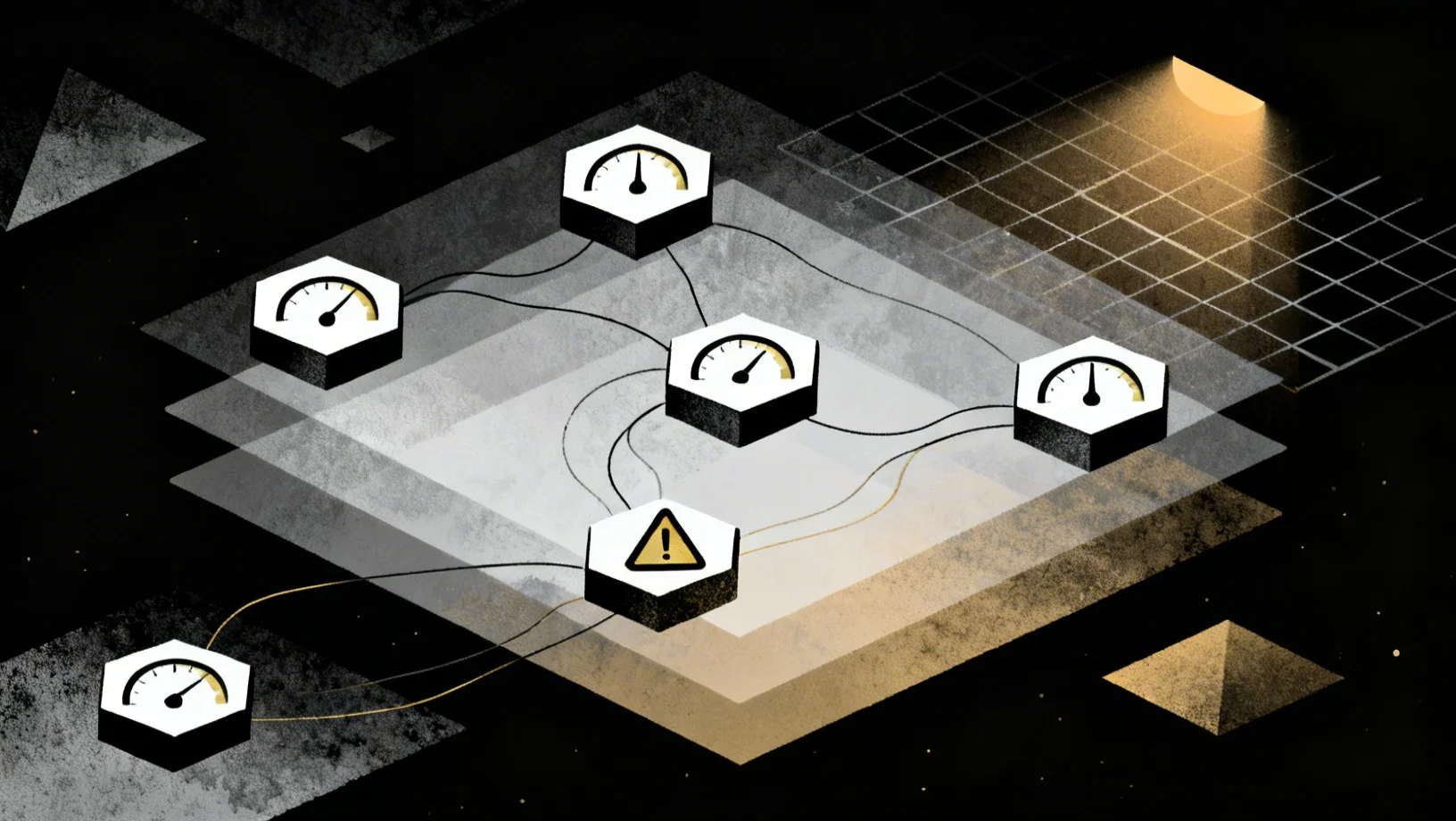
Why Single-Position Risk Management Is Not Enough
**The illusion of diversification** Having five positions across five protocols does not equal diversification if all five depend on the same oracle feed, the same wrapped asset, or the same chain. True diversification requires independence between positions, meaning that a failure in one does not systematically trigger losses in the others. Consider a portfolio with a lending position on Aave, an LP on Uniswap, and a [leveraged yield loop](/blog/yield-strategies/leveraged-yield-looping-defi-explained) on a money market. All three use ETH as their primary exposure. They sit on different protocols, but they share the same underlying price risk. That is correlation masquerading as diversification. **How risks compound across positions** Imagine ETH drops 20% in four hours. The Aave lending position approaches liquidation as your collateral value shrinks. The Uniswap LP suffers [impermanent loss](/blog/risk-management/impermanent-loss-explained-math-solana-lp-strategies) as the ETH/USDC ratio diverges sharply. The leveraged loop gets margin-called because the borrowed asset now exceeds the collateral buffer. All three "diversified" positions lose simultaneously because they share the same asset exposure. This is not a hypothetical edge case. It is what happens to most DeFi portfolios during market drawdowns. The positions that looked diversified in calm markets reveal their hidden correlations the moment volatility spikes. Single-position risk management misses this entirely because it evaluates each position in isolation rather than as part of an interconnected portfolio.
A Risk Taxonomy for Multi-Position Portfolios
Effective **DeFi portfolio risk management** requires a structured way to categorize and layer risks. Frameworks like the [Enterprise Ethereum Alliance's DeFi Risk Assessment Guidelines](https://entethalliance.org/specs/defi-risks/) and [Sentora's four-level risk taxonomy](https://medium.com/sentora/four-levels-of-risk-management-in-defi-2a1173465a46) provide useful starting points. The following four-layer taxonomy builds on these approaches and moves from broad infrastructure risks down to the specific interactions between positions.  **Layer 1: Chain-level risk** The blockchain itself is the foundation. Chain-level risks include network downtime, transaction congestion, and **MEV (Maximal Extractable Value)** extraction. Solana has experienced outages that prevented all on-chain activity, freezing users out of time-sensitive actions like collateral top-ups. Ethereum gas spikes during market crashes can make rebalancing uneconomical, turning a manageable drawdown into a forced liquidation. Layer 2 networks introduce sequencer centralization, where a single operator controls transaction ordering and inclusion. Chain-level risk affects every position you hold on that chain simultaneously. If 80% of your portfolio sits on one blockchain and it goes down during a crash, you have zero ability to manage any of those positions. **Layer 2: Protocol-level risk** Each protocol carries independent risks from smart contract bugs, governance vulnerabilities, oracle dependencies, and economic design flaws. Institutional frameworks like [Galaxy Research's SeC FiT PrO model](https://www.galaxy.com/insights/research/risk-rating-defi-crypto) score these across six domains, but the core principle is simple: every protocol has a risk surface, and shared components between protocols create hidden links. A thorough [DeFi due diligence checklist](/blog/risk-management/defi-due-diligence-checklist) covers these at the individual protocol level. But protocol risks are not truly independent when protocols share dependencies. Two lending markets using the same Pyth oracle feed share oracle risk. **Layer 3: Position-level risk** These are the risks specific to your individual position: liquidation thresholds, **health factors**, impermanent loss exposure, lock-up periods, and withdrawal queue delays. Position-level risks are the most visible and the most actively managed by experienced DeFi users, but they tell an incomplete story when viewed in isolation. For a deeper breakdown of position-level risks, see our guide on [DeFi yield risks explained](/blog/risk-management/defi-yield-risks-explained). **Layer 4: Cross-protocol correlation risk** **Cross-protocol correlation risk** is where portfolio-level thinking becomes essential. This layer captures how failures propagate between positions. A bridge exploit that depegs a wrapped asset affects every protocol that accepts that asset as collateral. A stablecoin depeg ripples through every pool, lending market, and vault that holds it. Composability, DeFi's greatest strength, is also the mechanism through which localized failures become systemic crises.
Position Sizing for DeFi Portfolios
Traditional finance has well-established position sizing models. DeFi needs its own version that accounts for the unique risk characteristics of on-chain positions. **Max allocation per protocol** A useful starting point: no more than 20-25% of deployable capital in any single protocol. This applies even to blue-chip protocols like Aave or Lido. Protocol risk is never zero, and concentration in a single protocol means a single exploit or governance failure can devastate your portfolio. For newer or less battle-tested protocols, tighter limits make sense. A 5-10% cap on protocols with less than six months of live operation or limited audit coverage reflects their higher smart contract risk. **Max allocation per chain** **Chain concentration risk** deserves its own allocation limit. If 80% of your positions are on Solana and the network experiences an extended outage during a market drawdown, your entire portfolio is frozen. A reasonable guideline is no more than 50-60% on any single chain, with the remainder distributed across at least one other ecosystem. This is separate from protocol diversification. You can be well-diversified across five Solana protocols and still hold 100% chain concentration risk. **Max allocation per asset type** Asset concentration is the most overlooked dimension. Providing liquidity to a SOL/USDC pool, using SOL as lending collateral, and staking SOL with a liquid staking protocol might look like three different strategies. But your portfolio is effectively a single directional bet on SOL price. Diversifying across [yield-bearing assets](/blog/yield-strategies/yield-bearing-assets) with different underlying exposures reduces this concentration. **Risk budgeting: allocating risk, not just capital** **Risk budgeting** is the concept that matters most for multi-position portfolios. A 10% allocation to a 3x leveraged loop carries far more portfolio risk than a 10% allocation to a stablecoin lending position. Weighting positions by their **risk-weighted allocation** rather than just their dollar value gives a more accurate picture of where your portfolio is vulnerable. A practical approach: assign a risk multiplier to each position type. Stablecoin lending might carry a 1x multiplier. Volatile pair LPs might carry a 2-3x multiplier. Leveraged strategies carry multipliers equal to their effective leverage. Multiply each position's dollar value by its risk multiplier to get the risk-weighted exposure, then check whether any single position dominates the total risk budget.
Identifying Hidden Correlations
The correlations that hurt most are the ones you do not see coming. Mapping dependencies across your positions is the most important analytical exercise in DeFi risk management. **Shared oracle dependencies** Multiple protocols using the same Chainlink or Pyth feed share **oracle dependency** risk. If the feed goes stale, reports an incorrect price, or gets manipulated, every position relying on it is affected simultaneously. A portfolio with lending positions on two different protocols that both use the same ETH/USD oracle is less diversified than it appears. **Shared asset exposure** This is the most common hidden correlation. Providing liquidity to an ETH/USDC pool while also using ETH as collateral in a lending protocol means both positions suffer from the same ETH price decline. Mapping every position's underlying asset exposure reveals whether your "diversified" portfolio is actually a concentrated directional bet. **Shared infrastructure** Bridge dependencies, shared keeper networks, and common liquidation bot infrastructure are less visible but equally dangerous. If three of your positions rely on the same cross-chain bridge for asset transfers, a bridge exploit affects all three. If your positions across multiple protocols all depend on the same liquidation bot network, congestion in that network during a crash affects your liquidation protection everywhere.  **How to map your correlation matrix** The practical exercise is straightforward. List every active position. For each one, tag its oracle dependency, primary asset exposure, chain, protocol, and any shared infrastructure (bridges, keepers, stablecoin issuers). Then look for clusters. If three positions share two or more tags, they are correlated. A table format works well: | Position | Chain | Oracle | Asset Exposure | Bridge/Infra | Protocol | |---|---|---|---|---|---| | Aave ETH lending | Ethereum | Chainlink ETH/USD | ETH | None | Aave v3 | | Raydium SOL/USDC LP | Solana | Pyth SOL/USD | SOL, USDC | None | Raydium | | Kamino leveraged loop | Solana | Pyth SOL/USD | SOL | None | Kamino | | Uniswap ETH/USDT LP | Ethereum | Chainlink ETH/USD | ETH, USDT | None | Uniswap v3 | | Marinade staking | Solana | N/A | SOL | None | Marinade | In this example, positions 2, 3, and 5 all share SOL asset exposure on Solana. Positions 1 and 4 share ETH exposure with the same Chainlink oracle on Ethereum. What looked like five independent positions actually contains two correlated clusters.
Monitoring Your Risk in Real Time
A risk framework is only useful if you can monitor it continuously. Checking each protocol individually is not practical when managing positions across multiple chains and protocols. **Health factor dashboards** For any lending or borrowing position, the **health factor** is the single most important metric to track. A health factor of 1.0 means liquidation is imminent. Most experienced users maintain health factors above 1.5 for conservative positions and above 2.0 for volatile collateral. Tracking health factors across all lending positions in a single view, rather than logging into each protocol separately, is essential for timely responses during market moves. A portfolio tracker that aggregates positions across protocols and chains, like the [Lince Portfolio Tracker](https://yields.lince.finance/tracker), provides this consolidated view. The alternative is maintaining a manual spreadsheet and checking each protocol dashboard individually, which breaks down exactly when you need it most: during fast-moving market events. **Setting alert thresholds** Alerts should fire before problems become emergencies. Recommended thresholds: • Health factor drops below 1.5 on any lending or looping position • Impermanent loss exceeds 5% of position value on any LP • TVL drops more than 20% in a protocol where you hold a position (signals potential instability) • A stablecoin in your portfolio deviates more than 0.5% from peg **Rebalancing triggers** Regular monitoring should identify when rebalancing is needed. Key **rebalancing triggers** include: • Position drift: a position has grown or shrunk to represent a significantly different share of your portfolio than intended • Risk concentration creep: new positions added without checking correlation, gradually increasing cluster risk • Protocol downgrade: negative governance changes, audit findings, or security incidents that increase the risk profile of a protocol you use For active portfolios, a weekly review is the minimum cadence. During periods of elevated volatility, daily checks are appropriate.
Stress Testing Your DeFi Portfolio
**Stress testing** means simulating adverse scenarios across your entire portfolio before they happen. The goal is to find out where your portfolio breaks and fix the weak points in advance. **Scenario planning** Work through each scenario and trace its impact across every position: • ETH drops 30% in 24 hours: Which positions approach liquidation? How much additional collateral would you need? Can you source it in time? • A major stablecoin depegs 5%: Which pools, lending positions, and vaults hold that stablecoin? What is the total exposure? • Gas fees spike 10x on Ethereum (or Solana experiences an outage): Can you still manage your positions? Which ones become unmanageable? • A protocol holding 20% of your capital announces a critical vulnerability: What is your exit plan? How quickly can you withdraw? For each scenario, calculate the portfolio-level impact, not just the individual position impact. A 30% ETH drop might be survivable in your lending position alone, but combined with the IL on your LP and the margin call on your loop, the aggregate loss could be far worse than any single position suggests.  **The cascade test** The cascade test is the most critical stress test for multi-position portfolios. Trace how a single trigger propagates through connected positions: • Oracle goes stale on the SOL/USD feed • Lending position cannot update its collateral valuation and approaches **cascade liquidation** • You sell LP tokens to free up capital for collateral top-up • LP exit during high volatility creates slippage, and you receive less than expected • Remaining LP position is now imbalanced and suffering accelerated impermanent loss • The capital freed was not enough because of the slippage, and the lending position gets liquidated anyway Mapping these cascades on paper before they happen is the single most underrated risk management practice. For more on how [liquidation cascades work on Solana](/blog/risk-management/defi-liquidations-solana) specifically, including the mechanics of on-chain liquidation bots, see our dedicated guide. **Recovery planning** A written recovery plan answers three questions before a crisis forces you to answer them under pressure: • What is your exit order? Which position do you unwind first? Prioritize exiting the highest-risk or most correlated positions first. • Where are your emergency reserves? Maintaining 10-20% of portfolio value in stablecoins outside of active DeFi positions provides the dry powder needed to top up collateral or exit positions without forced selling. • What is your communication plan? If you use a multisig or have positions managed through a DAO, who needs to be available to sign transactions during an emergency?
Tools and Practices for Portfolio-Level Risk Management
**Portfolio trackers** The most basic requirement is seeing your full exposure in one place. Checking Aave on Ethereum, Kamino on Solana, and a Uniswap LP separately means you are always working with an incomplete picture. A consolidated view across chains and protocols is not a luxury; it is a prerequisite for portfolio-level risk management. **On-chain alerts and monitoring** Beyond portfolio tracking, dedicated monitoring services can notify you of health factor changes, large protocol withdrawals, governance proposals that affect your positions, or security incidents. Setting up alerts is a one-time investment that pays for itself the first time it warns you before a problem escalates. **DeFi insurance as a portfolio tool** [DeFi insurance](/blog/risk-management/defi-insurance-protocol-coverage) makes the most sense as a portfolio-level tool rather than a per-position expense. The strategy: cover your largest single-protocol exposure rather than insuring every position. If 25% of your portfolio sits in one protocol, insuring that specific exposure provides the highest impact per premium dollar. The cost-benefit calculation is straightforward. Compare the annual premium cost against the position size and the probability-weighted expected loss. For a $50,000 position in a protocol with a 2-3% annual exploit probability, a $500-750 annual premium (1-1.5% of position value) is reasonable insurance. Covering a $5,000 position with a $200 premium rarely makes economic sense. **Checklists and review cadence** A weekly portfolio risk review should include: • Check health factors across all lending and leveraged positions • Review protocol news for any security incidents, governance changes, or audit findings • Assess whether any new positions have introduced correlations with existing holdings • Verify that position sizes still align with your target risk budget • Update your correlation matrix if you have added or removed positions • Run a quick mental cascade test: if the worst-performing asset drops another 20%, does the portfolio survive?
FAQs
### How many DeFi positions should I manage at once? There is no universal number. The right count depends on your ability to monitor and respond to each position. Most experienced users can effectively manage 5-10 active positions across 2-3 chains. Beyond that, the monitoring burden increases faster than the diversification benefit. If you cannot check all positions within 30 minutes during a market event, you probably have too many. ### What percentage of my portfolio should be in any single protocol? A common guideline is no more than 20-25% in any single protocol, even for established ones like Aave or Lido. For newer protocols with shorter track records or limited audit coverage, 5-10% is more appropriate. The key is that a single protocol exploit should not cause portfolio-level devastation. ### How do I know if my DeFi positions are correlated? Map each position by its oracle dependency, underlying asset exposure, chain, and protocol. If two or more positions share two or more of these attributes, they are correlated. The most common hidden correlation is shared asset exposure, where multiple strategies all depend on the same token price. A correlation matrix table makes these overlaps visible. ### What is cross-protocol risk in DeFi? Cross-protocol risk is the risk that a failure in one protocol propagates to others through shared dependencies. Examples include a stablecoin depeg affecting every protocol that holds it, a bridge exploit devaluing wrapped assets across multiple chains, or an oracle failure triggering liquidations in every lending market that uses the same price feed. Composability between protocols creates these hidden linkages. ### How often should I rebalance my DeFi portfolio? Weekly reviews are the minimum for active portfolios. During periods of elevated volatility, daily checks are appropriate. Rebalancing should be triggered by position drift (a position growing to represent an outsized share of your portfolio), risk concentration creep, or protocol-level downgrades rather than by a fixed calendar schedule. ### Should I buy DeFi insurance for all my positions? No. Insurance makes the most economic sense for your largest single-protocol exposure. Covering every position with insurance premiums would significantly erode your yield. Focus on positions where the premium cost is reasonable relative to the position size and the probability-weighted expected loss. A good rule: insure any single protocol that represents more than 20% of your total DeFi allocation. ### What is a DeFi health factor and why does it matter? A health factor is a ratio that indicates how close a lending or borrowing position is to liquidation. A health factor of 1.0 means the position is at the liquidation threshold. Most experienced users maintain health factors above 1.5 for conservative positions and above 2.0 for volatile collateral. Monitoring health factors across all lending positions in one view is essential because a market drawdown affects all of them simultaneously. ### How do I stress test my DeFi positions? Select 3-4 adverse scenarios: a 30% price drop in your primary asset, a stablecoin depeg, a chain outage during volatility, and a protocol exploit. For each scenario, trace the impact across every position in your portfolio, including cascading effects between positions. Calculate the aggregate portfolio loss, not just individual position losses. If any scenario results in losses you cannot absorb, reduce concentration in the correlated positions.
Conclusion
Managing risk across multiple DeFi positions requires portfolio-level thinking, not just per-position checklist habits. The four-layer risk taxonomy (chain, protocol, position, cross-protocol) provides the structure. Correlation mapping reveals the hidden dependencies. Position sizing by risk weight rather than dollar value prevents concentration. Stress testing and cascade analysis prepare you for the scenarios that will eventually arrive. The most dangerous assumption in DeFi is that diversification across protocols equals diversification of risk. It does not, unless the underlying exposures are genuinely independent. Five positions that all depend on the same asset price, the same oracle feed, or the same chain are one position wearing five disguises. Build the habit of weekly portfolio risk reviews. Map your correlations before adding new positions. Keep emergency reserves outside of active strategies. Write your recovery plan before you need it. Monitor all your DeFi positions and track risk exposure across protocols on the [Lince Portfolio Tracker](https://yields.lince.finance/tracker).