Rug Pull vs Exploit vs Bug: A Taxonomy of DeFi Failures
By Jorge Rodriguez — Risk Management
A precise taxonomy of DeFi failures based on intent, actor, and mechanism
A real-time classification framework for incidents hitting your timeline
Recovery probabilities and insurance implications by failure type
Introduction
When a DeFi protocol loses user funds, the community reaches for familiar labels: rug pull, exploit, hack. But these terms describe fundamentally different events with different causes, different perpetrators, and very different chances of recovering your capital. Understanding the difference between a **rug pull vs exploit** is not just a vocabulary exercise. It changes how you respond to an incident, whether your insurance claim is valid, and what legal recourse exists. Calling every loss a "hack" flattens the risk landscape and leads to bad decisions. With over $2.9 billion lost across DeFi, CeFi, and gaming platforms in 2024 alone, according to [Immunefi's crypto losses reports](https://immunefi.com/blog/), the need for precise failure classification has never been more urgent. Experienced yield farmers evaluating exposure across protocols on tools like the [Lince Yield Tracker](https://yields.lince.finance/tracker) need to know whether a failure in one protocol signals risk in their other positions or represents an isolated event. This article builds a precise taxonomy of DeFi failures, gives you a framework to classify incidents in real time, and explains why the distinction between rug pulls, exploits, and bugs matters for your portfolio. 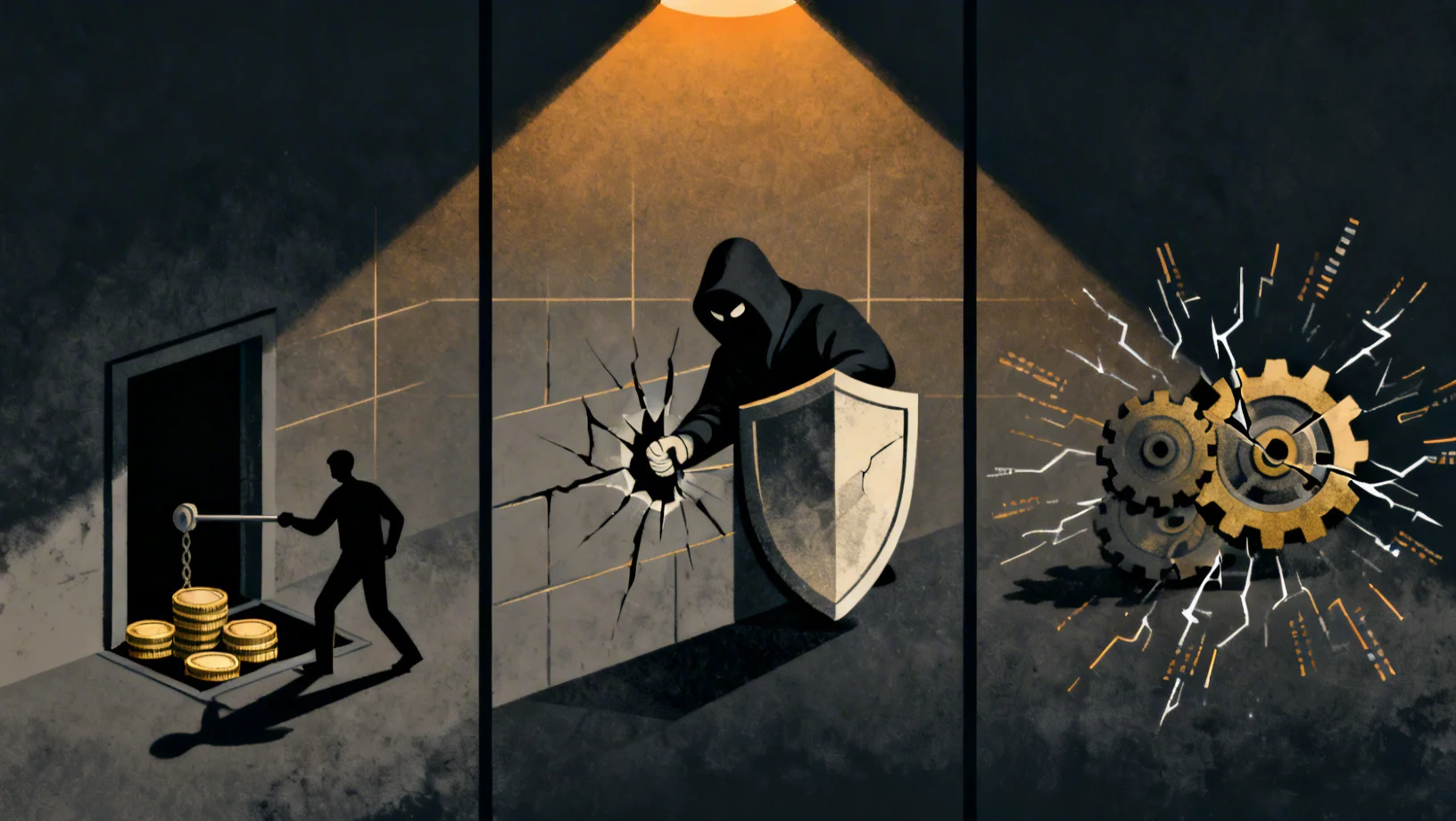
The Three Categories of DeFi Failure
**Why Classification Matters** Intent is the axis that separates these categories. A **rug pull** is premeditated theft by insiders. An **exploit** is an outsider weaponizing a vulnerability the team never intended. A **bug** is a code defect that causes unintended behavior, sometimes without any malicious actor involved at all. The same $50 million TVL loss can fall into any of these categories depending on who acted and why. And the category determines everything that follows: community response, governance action, insurance claims, legal implications, and the probability of recovering funds. **Quick-Reference Framework** Before diving into each category, here is the high-level distinction: Category | Actor | Intent | Typical Mechanism | Recovery Likelihood ---|---|---|---|--- Rug Pull | Insider / Team | Premeditated theft | LP removal, backdoor mint, treasury drain | Under 5% Exploit | External attacker | Opportunistic extraction | Reentrancy, oracle manipulation, flash loan attack | 20-30% Bug | No villain (or ambiguous) | Accidental flaw | Logic error, rounding bug, failed upgrade | Highest when team is legitimate Each of these categories has distinct on-chain signatures, different warning signals, and different playbooks for response. Understanding these differences is a core part of [evaluating DeFi yield risks](/blog/risk-management/defi-yield-risks-explained).
Rug Pulls: Insider Theft by Design
**Definition and Mechanics** A rug pull occurs when the team or insiders behind a protocol deliberately extract value from users. The protocol was designed, at least in part, to facilitate theft. Methods include sudden liquidity removal from decentralized exchanges, infinite mint functions hidden in the token contract, backdoor admin keys that bypass normal governance, and slow-drain treasury siphoning over weeks or months. The defining characteristic is insider intent. The people who built the protocol are the ones who stole from it. **Hard Rug vs Soft Rug** Not all rug pulls look the same. A **hard rug** is sudden and total: one transaction drains the liquidity pool, the token goes to zero, and the team disappears. These are dramatic and make headlines. A **soft rug** is slower and harder to detect. The team gradually abandons development, dumps their token allocation over weeks, extracts fees without delivering on the roadmap, and eventually stops responding to the community. Soft rugs are more common and often cause more cumulative damage because users stay deposited longer, hoping for a turnaround that never comes. **On-Chain Signatures of a Rug Pull** Experienced users can identify rug pull risk before it happens by examining: • Sudden or unexplained LP removal from the primary trading pair • Admin-only functions called without governance approval or community notice • Token contracts with hidden mint, pause, or blacklist capabilities • Anonymous team with no locked liquidity or locked for suspiciously short periods • Deployer wallet receiving large token allocations with no vesting schedule These signals overlap with general [due diligence checks](/blog/risk-management/defi-due-diligence-checklist), but the key differentiator is that rug pull risk centers on insider behavior rather than code quality. **Notable Examples** Merlin DEX lost $1.8 million in 2023 through a backdoor function that persisted despite the protocol having passed an audit. The audit covered the code as written but could not account for the team's intent to use the backdoor. AnubisDAO drained $60 million in 2021, and Squid Game token became one of the most public rug pulls when liquidity was pulled during peak hype. Data from [Chainalysis](https://www.chainalysis.com/blog/crypto-crime-midyear-2024-update/) shows rug pull volume declining roughly 66% year over year. But per-incident impact has surged as attackers target higher-TVL protocols.
Exploits: External Attackers, Unintended Entry Points
**Definition and Mechanics** An **exploit** occurs when an outsider discovers and weaponizes a vulnerability the team did not intend. The protocol was built in good faith but contained a flaw. The attacker is external, not affiliated with the team, and the vulnerability was not planted deliberately. Exploit vectors include **reentrancy attacks** (where a function is called recursively before the first invocation completes), **flash loan attacks** (using uncollateralized single-transaction loans to manipulate protocol state), **oracle manipulation** (exploiting price feed dependencies), **governance attacks** (abusing token voting mechanisms), and cross-chain bridge attacks. **Common Exploit Vectors** For yield farmers evaluating protocol risk, understanding the major attack categories matters: • Reentrancy: Rari Capital lost $80 million when an attacker re-entered a withdrawal function before balances updated. This class of vulnerability has been known since 2016 but continues to appear in forks and novel implementations. • Flash loan oracle manipulation: Dozens of Compound forks have been drained by attackers who borrow massive amounts in a single transaction to skew price oracles, manipulate collateral values, and extract protocol funds. • Governance attacks: Beanstalk lost $182 million when an attacker used a flash loan to acquire enough voting power to pass a malicious governance proposal in a single block. • Bridge exploits: Wormhole lost $320 million and Ronin Bridge lost $625 million. Cross-chain bridges remain one of the highest-risk categories in DeFi because they require trust assumptions across multiple chains.  **The White Hat and Gray Hat Spectrum** Exploits exist on a spectrum that rug pulls do not. Some attackers return funds. Euler Finance's attacker returned $197 million after negotiations. Some negotiate **bug bounty** payouts. Others disappear entirely. This recovery spectrum is one of the sharpest differences between exploits and rug pulls. Rug pull perpetrators have no incentive to return funds because the theft was the point. Exploit attackers sometimes face legal pressure, ethical considerations, or simply accept a bounty as a safer outcome than prosecution. **Notable Examples** Euler Finance (2023, $197 million, fully returned), Curve pool exploit (2023, $70 million via a Vyper compiler bug that was technically a bug in the toolchain rather than in Curve's own code), and Wormhole (2022, $320 million, Jump Trading covered losses). These illustrate the range of exploit outcomes and the blurry lines between categories. The [Rekt.news leaderboard](https://rekt.news/leaderboard/) maintains a comprehensive incident database for tracking these events.
Bugs: Flaws Without a Villain
**Definition and Mechanics** A **bug** is a code defect that causes unintended behavior. It may or may not be exploited by an external party. In some cases, the protocol itself misbehaves without any attacker involved at all. The Compound COMP over-distribution is the clearest example. In 2021, a governance upgrade introduced a bug that distributed over $80 million in COMP tokens to users who were not entitled to them. No attacker manipulated the protocol. The code simply did something its authors did not intend. Other bug categories include failed liquidation logic (where undercollateralized positions are not liquidated correctly), broken oracle integrations (where stale or incorrect prices cause cascading errors), and rounding errors that drain pools gradually over thousands of transactions. **Bug vs Exploit: The Intent Boundary** When someone discovers a bug and deliberately extracts value from it, the incident crosses into exploit territory. But some bugs cause damage autonomously. The line is whether a human chose to weaponize the flaw. This distinction matters for insurance claims and legal liability. A protocol that loses funds to an autonomous bug has a different governance response than one where an identified attacker extracted funds through a known vulnerability. Understanding whether a protocol's loss was a bug or exploit also affects how you assess [protocol insolvency risk](/blog/risk-management/defi-protocol-insolvency-risk). Bugs in legitimate protocols often trigger treasury-funded compensation, while exploits may leave the protocol unable to make users whole. **The "Code Is Law" Dilemma** If a smart contract distributes tokens according to its code, is claiming them exploitation? The Compound incident split the community. Some argued users were simply interacting with the contract as deployed. Others argued it was clearly unintended and claiming excess tokens was ethically wrong. Legally, the Avraham Eisenberg case set an important precedent. Eisenberg was convicted for his $115 million Mango Markets manipulation, despite arguing that he simply used the protocol as designed. The court ruled that "code is law" is not a legal defense for market manipulation. This gray area matters for governance response and personal legal exposure. **Notable Examples** Compound COMP bug (2021, $80 million+ over-distributed), Level Finance rounding error (2023), and various liquidation cascade bugs across lending protocols that have caused significant but often under-reported losses.
A Decision Framework: Classifying Incidents in Real Time
When a DeFi incident hits your timeline, you need to classify it quickly to determine your response. Run through these steps: **Step 1: Who holds the funds now?** Check whether the funds went to an insider address (team wallet, deployer, known associated address) or an external address with no prior connection to the protocol. If insider, this strongly suggests a rug pull. If external, move to step 2. **Step 2: Was the vulnerability intentional?** Did the contract contain a function designed to enable the fund extraction (backdoor mint, unprotected admin withdrawal)? If yes, this is a rug pull regardless of who triggered it. If the vulnerability was an unintended flaw, move to step 3. **Step 3: Was the flaw weaponized by a human actor?** Did someone craft a specific transaction or series of transactions to exploit the flaw? If yes, this is an exploit. If the contract simply misbehaved on its own (incorrect distributions, broken logic during normal operation), this is a bug.  **Why Accurate Classification Changes Your Response** Different failure types require different playbooks: • Rug pull: Exit remaining positions immediately. Check for related protocols by the same team. There is no recovery to wait for. • Exploit: Wait for the **post-mortem** (technical incident report from the team or a security firm). Check if your positions use the same code or dependencies. Monitor for fund recovery negotiations. Review the [exploit aftermath playbook](/blog/risk-management/defi-protocol-exploit-aftermath) for structured response steps. • Bug: Check governance proposals. The team may patch and compensate from treasury reserves. Bugs in legitimate protocols often have the best outcomes for depositors because the team is motivated to restore trust. Misclassifying an exploit as a rug pull might cause you to panic-sell positions in a protocol that will actually recover. Misclassifying a rug pull as a bug might cause you to wait for compensation that will never come.
How Failure Type Affects Recovery
**Recovery Statistics by Category** The probability of recovering funds varies dramatically by failure type: • Rug pulls: Under 5% recovery rate, essentially zero for hard rugs. The perpetrators designed the theft and typically use mixers, bridge hops, and chain-hopping to obscure fund flow. Law enforcement has improved at tracing crypto funds, but recovery remains rare. • Exploits: 20-30% partial recovery rate through a combination of negotiation, bug bounties, and law enforcement pressure. The Euler case ($197 million fully returned) is exceptional but not unique. Many exploiters accept a 10% bounty to avoid prosecution. • Bugs: Highest recovery rate when the team is legitimate and the protocol has treasury reserves. Compound eventually recovered most over-distributed COMP through governance action and community appeals.  **Insurance and Coverage Implications** DeFi insurance protocols like Nexus Mutual, InsurAce, and Neptune Mutual typically cover exploits but explicitly exclude rug pulls. Bug coverage varies by policy terms. Understanding the classification directly affects whether your insurance claim is valid. This means the same dollar loss from the same protocol might be covered or not covered depending on how the incident is classified. For a detailed breakdown of what DeFi insurance does and does not cover, see [DeFi insurance protocol coverage](/blog/risk-management/defi-insurance-protocol-coverage). **Legal Recourse Differences** The legal landscape differs sharply by category: • Rug pulls constitute fraud and theft. Criminal prosecution is possible if perpetrators are identified. Civil suits have succeeded in multiple jurisdictions. • Exploits occupy a gray area. The Eisenberg conviction suggests that deliberately manipulating protocol mechanics for profit can be prosecuted. But many exploit cases remain legally ambiguous, especially when attackers are anonymous or operate across jurisdictions. • Bugs typically offer no legal recourse unless negligence is proven. A protocol that ships unaudited code and loses user funds to a bug may face negligence claims, but this area of law is largely untested.
Protecting Your Positions Across All Failure Types
**Protocol-Level Due Diligence** Before depositing, evaluate protocols against signals that correlate with each failure type:  Signal | Rug Pull Risk | Exploit Risk | Bug Risk ---|---|---|--- Anonymous team | High | Neutral | Neutral No audit | Medium | High | High Single admin key (EOA) | High | High | Low Upgradeable proxy without timelock | High | Medium | Medium Forked code with modifications | Medium | High | High No bug bounty program | Low | High | High TVL concentration in few wallets | Medium | Low | Low Audit status, team identity, **time-locked contracts**, **multisig governance**, TVL distribution, and open-source code are the foundation. For a complete evaluation framework, use the [DeFi due diligence checklist](/blog/risk-management/defi-due-diligence-checklist). Understanding [how to read a DeFi audit report](/blog/risk-management/how-to-read-defi-audit-report) is particularly valuable for distinguishing between protocols that are genuinely audited versus those that obtained a rubber-stamp review. **Portfolio-Level Risk Management** No amount of protocol-level due diligence eliminates all risk. Portfolio construction is your second line of defense: • Position sizing: never allocate more than 10-15% of your portfolio to a single protocol. A rug pull or exploit at 10% allocation is painful. At 80% allocation, it is devastating. • Chain diversification: spreading deposits across Ethereum, Solana, Base, and other ecosystems means a chain-level incident (bridge exploit, validator compromise) does not wipe out everything. • Monitoring: set on-chain alerts for large withdrawals, admin function calls, and TVL drops on protocols where you are deposited. Social monitoring catches team behavior changes early. • Exit plans: define in advance what triggers a withdrawal. If TVL drops 30% in a week, if the team makes unannounced contract changes, or if a similar protocol gets exploited using a shared codebase, you should already know what you will do. For a comprehensive approach to managing exposure across multiple yield positions, see [DeFi risk management for multiple positions](/blog/risk-management/defi-risk-management-multiple-positions). The [Lince Yield Tracker](https://yields.lince.finance/tracker) can help you monitor yields across protocols and chains to spot anomalies that might signal emerging problems.
FAQs
### What is the difference between a rug pull and an exploit in DeFi? A rug pull is premeditated theft by the protocol's own team or insiders who extract deposited funds. An exploit is an external attacker discovering and weaponizing an unintended vulnerability in the protocol's code. The core difference is who the attacker is and whether the vulnerability was planted intentionally. ### Can a DeFi bug turn into an exploit? Yes. A bug becomes an exploit when someone discovers the flaw and deliberately crafts transactions to extract value from it. The Compound COMP over-distribution started as a bug, but users who knowingly claimed tokens they were not entitled to crossed into exploit territory. The line depends on whether a human intentionally weaponized the flaw. ### Are DeFi exploits illegal? The legal status depends on jurisdiction and intent. The conviction of Avraham Eisenberg for the Mango Markets manipulation established that deliberately manipulating protocol mechanics for profit can constitute fraud, even if the attacker only used functions available to any user. However, many exploit cases remain legally untested, especially when attackers are anonymous. ### How can I tell if a protocol was rugged or exploited? Check where the funds went. If they moved to insider wallets (deployer, team addresses), it was likely a rug pull. If they went to an external address with no prior connection to the protocol, it was likely an exploit. Also check whether the vulnerability was an intentional backdoor (rug pull) or an unintended flaw in otherwise legitimate code (exploit). Post-mortem reports from security firms like Halborn and SlowMist provide definitive classifications. ### What are the chances of getting funds back after a DeFi exploit? Exploits have a roughly 20-30% partial recovery rate. Recovery happens through negotiation with the attacker (who may accept a bug bounty to avoid prosecution), law enforcement intervention, or the protocol's own treasury covering losses. Euler Finance recovered the full $197 million. Other cases see 10-50% returned. Rug pulls, by contrast, have under 5% recovery. ### Does DeFi insurance cover rug pulls? Most DeFi insurance protocols, including Nexus Mutual and InsurAce, explicitly exclude rug pulls from coverage. They typically cover smart contract exploits, oracle manipulation, and protocol insolvency. This makes accurate incident classification directly relevant to whether your insurance claim will be honored. ### What is a flash loan exploit? A flash loan exploit uses uncollateralized loans that must be borrowed and repaid within a single blockchain transaction. Attackers use them to temporarily amass enormous capital, manipulate prices or governance votes, extract value from a vulnerable protocol, and repay the loan, all atomically. The Beanstalk governance attack used a flash loan to acquire enough voting power to pass a malicious proposal and drain $182 million. ### How do audits prevent exploits and rug pulls? Audits help prevent exploits by identifying code vulnerabilities before attackers find them. They are less effective against rug pulls because an audit examines code quality, not team intent. Merlin DEX passed an audit but was still rugged through a backdoor function. Multiple audits from different firms reduce exploit risk significantly, but no audit can guarantee a team will not act maliciously.
Conclusion
Precise language matters in DeFi risk management. Calling every protocol loss a "hack" obscures the real risk landscape and leads to responses that do not match the situation. Rug pulls, exploits, and bugs have different causes, different warning signs, different recovery profiles, and different insurance implications. A rug pull means exit immediately with no expectation of recovery. An exploit means wait for the post-mortem and monitor for negotiated fund returns. A bug in a legitimate protocol often has the best outcome for depositors. The classification framework in this article gives you a repeatable process: check who holds the funds, whether the vulnerability was intentional, and whether a human actor weaponized a flaw. Map those answers to the correct category and respond accordingly. Better classification makes you a better risk manager. Track your yield exposure across protocols with different risk profiles, monitor the signals that precede failures, and maintain the portfolio diversification that limits damage when an incident does occur. Evaluate protocol risk and track yield exposure across chains on the [Lince Yield Tracker](https://yields.lince.finance/tracker).