Stablecoin Risk Tiers: Not All Stablecoins Are Created Equal
By Jorge Rodriguez — Stablecoins
A risk tier framework to classify any stablecoin from institutional-grade to experimental
How stablecoin choice silently compounds risk in your DeFi yield positions
A practical checklist for evaluating stablecoin safety before deploying capital
Introduction
You check your DeFi position and see stablecoin yield: 12% APY. Sounds great. But what stablecoin is backing that yield? The answer changes your risk profile more than most DeFi users realize. Stablecoin risks are the most underestimated variable in yield farming. Every position you open carries protocol risk, smart contract risk, and liquidity risk. But underneath all of those sits the stablecoin itself, a foundational layer that can crack and bring everything above it down. UST proved that catastrophically in 2022. USDC's brief **depeg** during the SVB banking crisis in 2023 showed that even well-regulated stablecoins can wobble under systemic stress. This article introduces a risk tier framework that classifies stablecoins from institutional-grade to experimental. It covers five risk dimensions you should evaluate for any stablecoin, explains how stablecoin risk compounds inside yield strategies, and provides a practical checklist for assessing any stablecoin before you deposit capital. If you want a broader view of all risk categories in DeFi, start with the [DeFi yield risks overview](/blog/risk-management/defi-yield-risks-explained). 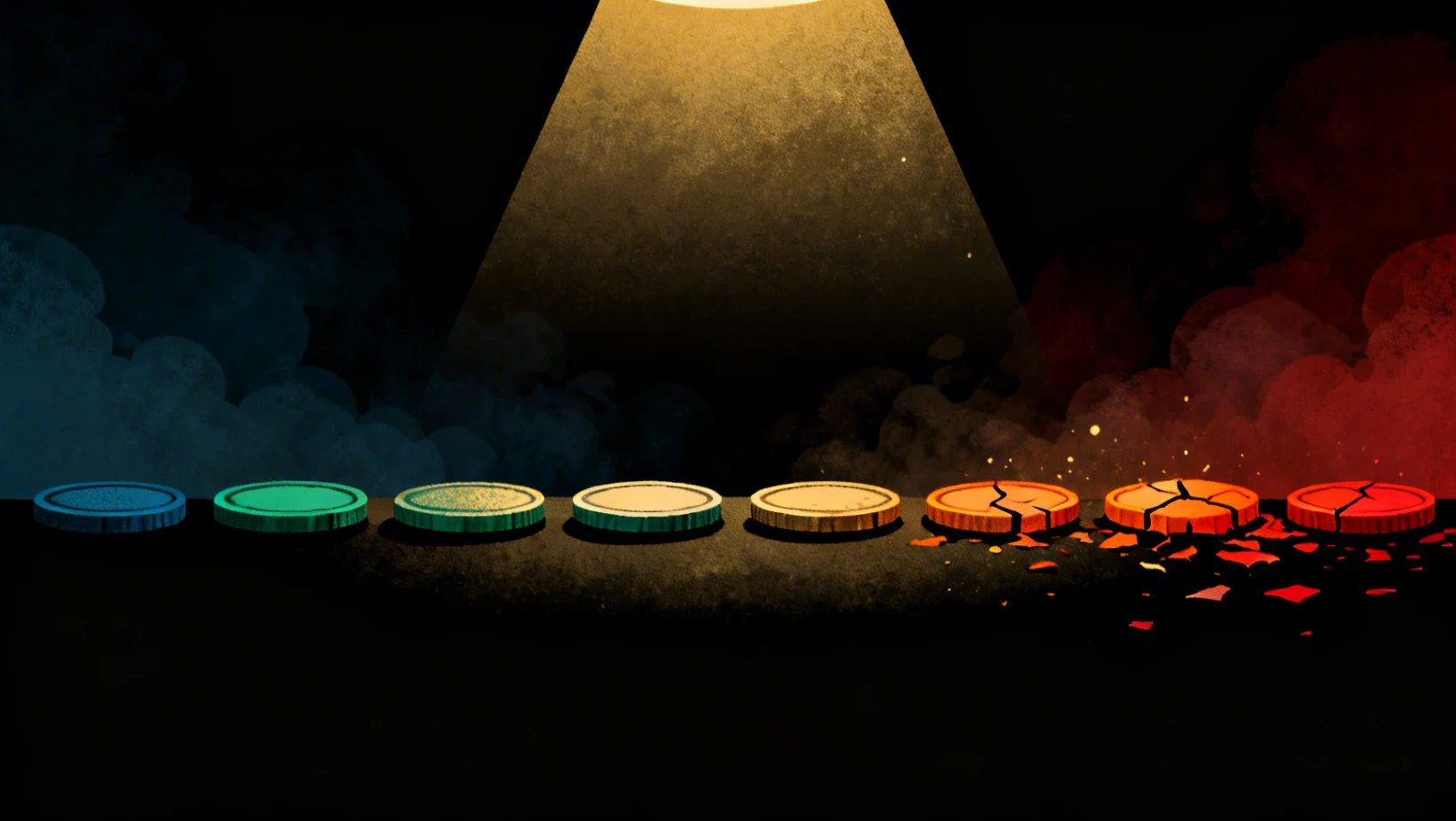
Why Stablecoin Risk Matters for Yield
**The hidden variable in every DeFi position** Most yield farmers spend hours evaluating protocols, reading audit reports, and checking TVL trends. Then they deposit into whichever stablecoin pool has the highest APY without questioning the stablecoin itself. That is like inspecting the walls of a house but ignoring the foundation. Your yield is not just protocol risk plus smart contract risk. The stablecoin is its own risk layer. When a stablecoin depegs, it does not matter how well-audited the lending protocol is or how deep the liquidity pool was last week. Your principal shrinks in real terms regardless. **The risk is not binary** Stablecoins are not simply safe or dangerous. They exist on a spectrum, and the differences between them are structural, not cosmetic. A fiat-backed stablecoin with segregated reserves and regular attestations carries a fundamentally different risk profile than a **delta-neutral** synthetic that depends on perpetual futures funding rates staying positive. The categories include fiat-backed, crypto-overcollateralized, delta-neutral synthetic, and algorithmic. Each has distinct failure modes and different recovery profiles when things go wrong. Understanding where a stablecoin falls on this spectrum is the first step toward making informed yield decisions. Tools like the [Lince Yield Tracker](https://yields.lince.finance/tracker) let you compare stablecoin yields across protocols and chains, but the yield number alone does not tell you the risk story. That requires a framework.
The Five Risk Dimensions
Every stablecoin can be evaluated across five dimensions. These are not abstract categories. Each one represents a concrete failure mode that has already played out in real markets.  **Reserve composition and transparency** What backs the stablecoin? The answer ranges from US Treasury bills in segregated accounts to nothing at all. **Reserve composition** determines the fundamental solvency of the issuer. A stablecoin backed by T-bills and cash has a different risk profile than one backed by commercial paper, crypto collateral, or a mathematical formula. Transparency matters as much as composition. An **attestation** is a point-in-time snapshot where an accounting firm confirms reserves exist. It is less rigorous than a full audit but still provides useful verification. Some issuers publish monthly attestations (Circle for USDC), while others have historically resisted disclosure (Tether). S&P Global's **Stablecoin Stability Assessment (SSA)** framework provides an independent rating that factors in reserve quality, and their [methodology is publicly available](https://www.spglobal.com/ratings/en/products/stablecoin-stability-assessment). **Peg mechanism and redemption design** The **peg mechanism** determines how a stablecoin maintains its target price, and more importantly, how it fails. Direct **redemption** stablecoins like USDC let you hand in tokens and receive dollars at par. That creates a hard floor: if the price drops below $1, arbitrageurs redeem and buy the dip until parity restores. Delta-neutral stablecoins like USDe use a hedging strategy where long spot and short perpetual futures positions offset each other. This works until funding rates turn negative for extended periods, creating **funding rate risk** that can erode the peg. Algorithmic stablecoins, the category that produced UST, relied entirely on market incentives with no hard collateral backing. That category is effectively dead for serious capital. **Regulatory standing** Regulation is a risk reducer, not just a compliance checkbox. The **GENIUS Act** in the US and **MiCA** in Europe have created formal licensing frameworks for stablecoin issuers. Licensed issuers like Circle and Paxos face reserve requirements, reporting obligations, and regulatory oversight that reduce the probability of fraud or insolvency. Offshore issuers operate with less oversight. Tether's BVI registration provides limited regulatory protection for holders. DeFi-native stablecoins like GHO or crvUSD have no traditional issuer to regulate at all, which creates a different risk profile: no single point of regulatory failure, but also no regulatory recourse if something goes wrong. For more on how centralized points of failure affect DeFi positions, see the [counterparty risk guide](/blog/risk-management/counterparty-risk-defi). **Smart contract and governance risk** Immutable contracts cannot be changed, which means bugs are permanent but upgrades are impossible. Upgradeable contracts can be patched, but they introduce **admin keys** that give privileged access to contract owners. Multisig control, DAO governance votes, and timelocks all affect how much trust you are placing in the stablecoin's operators. Freeze and blacklist capabilities exist on most fiat-backed stablecoins. Circle can freeze USDC addresses, which is a security feature (recovering stolen funds) and a censorship risk simultaneously. Understanding these trade-offs matters when choosing where to allocate capital. **Liquidity depth and depeg recovery history** On-chain liquidity in Curve and Uniswap pools, combined with CEX order book depth, determines how quickly you can exit a position if the stablecoin starts losing its peg. A stablecoin with $50M in DEX liquidity and a $5B market cap has a very different exit profile than one with $500M in liquidity and the same market cap. Historical depeg events reveal structural information. USDC dropped to $0.88 during the SVB crisis and recovered within three days once the bank was backstopped. UST dropped to $0.10 and never recovered. The pattern of depegs, their causes, and the recovery timeline tell you more about a stablecoin's resilience than any marketing page.
Stablecoin Risk Tiers
Using the five dimensions above, stablecoins can be classified into risk tiers. This is not a static ranking. Stablecoins can move between tiers as their reserves, regulation, or market conditions change. But at any given moment, the tier framework helps you understand what you are holding.  **Tier 1: Institutional-grade (lowest risk)** USDC and PYUSD represent the current standard for low-risk stablecoins. Both are backed by full fiat reserves held in segregated accounts. Circle publishes monthly attestations from Deloitte for USDC. PayPal's PYUSD is issued by Paxos with similar reserve standards. Both operate under US regulatory frameworks. Both offer direct redemption at par. Both have deep liquidity across major DEXs and CEXs. S&P has given USDC a strong stability rating under their SSA framework. Tier 1 stablecoins typically offer the lowest DeFi yields precisely because the market prices in their lower risk. When USDC lending yields sit at 3-5%, that is not an inferior product. It is a lower **risk premium** reflecting higher safety. Stablecoin | Backing | Regulation | Redemption | Liquidity ---|---|---|---|--- USDC | T-bills, cash | US (Circle) | Direct at par | Very deep PYUSD | T-bills, cash | US (Paxos) | Direct at par | Moderate **Tier 2: Battle-tested with trade-offs (moderate risk)** USDT, DAI/USDS, and FRAX dominate this tier. Each has years of market history and deep liquidity, but comes with specific caveats that prevent a Tier 1 classification. USDT is the most liquid stablecoin in crypto, with a market cap exceeding $140B. However, Tether's reserve transparency has been a persistent concern. The company publishes quarterly attestations, but the composition has shifted over time and includes less liquid assets. S&P [downgraded USDT to a "Weak" stability rating](https://www.coindesk.com/policy/2025/11/26/s-and-p-downgrades-tether-s-usdt-citing-falling-bitcoin-prices-as-risk) in November 2025, citing exposure to bitcoin price risk in reserves. DAI (now transitioning to USDS under Sky/Maker) is **overcollateralized** by crypto assets and real-world assets. The overcollateralization provides a buffer, but the governance complexity of MakerDAO and its exposure to RWAs introduce different risk vectors. FRAX has phased out its algorithmic component, but the hybrid history affects market perception. Stablecoin | Backing | Regulation | Redemption | Liquidity ---|---|---|---|--- USDT | Mixed reserves | BVI (Tether) | Via Tether (min $100K) | Deepest DAI/USDS | Crypto + RWA | None (DAO) | Market-based | Deep FRAX | Hybrid | None | Market-based | Moderate **Tier 3: Innovative but higher risk (elevated risk)** USDe (Ethena), GHO (Aave), and crvUSD (Curve) represent newer designs with less time in market. Each introduces a novel mechanism that offers potential advantages but carries untested risks. USDe uses a delta-neutral strategy: holding staked ETH while shorting ETH perpetual futures. When funding rates are positive, this generates yield. When funding rates turn negative for extended periods, the strategy bleeds capital. The mechanism has worked through several market cycles, but it has not been tested through a prolonged bear market with sustained negative funding. GHO is Aave's native stablecoin, backed by the collateral deposited in Aave's lending pools. crvUSD uses Curve's LLAMMA mechanism for soft liquidations. Both benefit from being embedded in major protocols but carry the governance and smart contract risks of those protocols. These stablecoins often offer higher yields than Tier 1 or Tier 2 options. That yield differential is the market pricing in the additional risk. Whether the compensation is sufficient depends on your risk tolerance and position sizing. Stablecoin | Backing | Regulation | Redemption | Liquidity ---|---|---|---|--- USDe | Delta-neutral hedge | None | Market-based | Growing GHO | Aave collateral | None (DAO) | Market-based | Moderate crvUSD | LLAMMA mechanism | None (DAO) | Market-based | Moderate **Beyond Tier 3: Experimental territory** Purely algorithmic stablecoins, new forks without audits, and stablecoins on minor chains with minimal liquidity fall into this category. UST is the cautionary tale that defines this tier. If the stabilization mechanism sounds too clever and the team cannot explain the failure modes, the risk is likely higher than the yield compensates for. Serious capital should avoid this tier entirely. The yield premiums look attractive precisely because they need to attract capital that would otherwise go to safer options.
How Stablecoin Risk Compounds in Yield Strategies
**Stacking risk layers** When you deposit USDT into a lending protocol that rehypothecates to a vault that wraps into an LP position, you are stacking four risk layers: stablecoin risk, lending protocol risk, vault smart contract risk, and LP liquidity risk. These layers multiply rather than add. A 5% probability of failure in each of four independent layers gives you roughly an 18.5% combined probability of at least one failing, not 20%. In practice, these risks are correlated, which makes the math worse. A stablecoin depeg triggers liquidity withdrawals, which increases protocol stress, which can trigger liquidation cascades. The [guide on managing risk across multiple DeFi positions](/blog/risk-management/defi-risk-management-multiple-positions) covers these correlation effects in detail. **The yield premium as a risk signal** When USDe pays 15% and USDC pays 4%, the 11% spread is the market's estimate of the additional risk you are taking. This is the **risk premium**, and it is one of the most honest signals in DeFi. Markets are not always perfectly efficient, but persistent yield differentials between stablecoins of different tiers reflect genuine differences in risk. This does not mean high-yield stablecoins are bad investments. It means the yield must compensate for the risk. If you expect a 2% probability of a significant depeg that costs you 30% of principal, you need at least 0.6% of additional yield just to break even on expected value, before accounting for the psychological and liquidity costs of a depeg event.  **Diversification across tiers** The simplest risk management strategy for stablecoin exposure is diversification. Holding positions across Tier 1 and Tier 2 stablecoins limits the blast radius of any single depeg event. If 30% of your capital is in USDC, 40% in USDT, and 30% in DAI, a USDC depeg to $0.90 costs you 3% of total portfolio value rather than 10%. The [Lince Yield Tracker](https://yields.lince.finance/tracker) lets you compare yields across stablecoins and protocols, making it easier to find opportunities in each tier and build a diversified stablecoin allocation.
Evaluating Any Stablecoin: A Practical Checklist
Before deploying capital into any stablecoin yield position, run through these four checks. They take 15-20 minutes and can save you from losses that no APY would compensate for. For a broader protocol-level evaluation process, see the [DeFi due diligence checklist](/blog/risk-management/defi-due-diligence-checklist). **Reserve verification** Find the issuer's attestation or audit reports. For USDC, these are on Circle's transparency page. For USDT, check Tether's quarterly reports. Look for three things: • What asset types back the stablecoin (T-bills, cash, commercial paper, crypto, other) • How concentrated the reserves are in any single asset or custodian • Whether maturity matching exists between reserves and potential redemption demands If you cannot find reserve information within 10 minutes of searching, that is itself a risk signal. **On-chain liquidity check** Check Curve and Uniswap pool depths for the stablecoin. Compare the total DEX liquidity to the stablecoin's market cap. A rough guideline: if DEX liquidity is less than 1% of market cap, large exits will cause significant slippage during stress events. Also check whether liquidity is concentrated in a single pool or spread across multiple venues. Concentration in one pool means a single LP withdrawal can destabilize the entire market. **Governance and contract review** Check whether the stablecoin's smart contracts are upgradeable or immutable. If upgradeable, look for timelocks (how long before an upgrade takes effect) and multisig requirements (how many signers must approve). Resources like DeFi Safety reports and protocol audit pages provide this information. Also check for freeze and blacklist functions. These exist on most fiat-backed stablecoins and some DeFi-native ones. Understanding these capabilities helps you assess censorship risk alongside security benefits. **Depeg history** Review historical peg data on DefiLlama or CoinGecko. Look for: • How many depeg events have occurred and how severe they were • What caused each depeg (external shock, internal mechanism failure, liquidity crisis) • How long recovery took and whether full parity was restored • Whether the same failure mode could repeat or has been structurally addressed A stablecoin that depegged once due to an external shock and recovered quickly is less concerning than one that has experienced multiple depegs from different causes. Consider [insurance options](/blog/risk-management/defi-insurance-protocol-coverage) for positions in stablecoins with higher depeg risk profiles.
FAQ
### How do I know if a stablecoin is safe to use in DeFi? Evaluate five dimensions: reserve composition and transparency, peg mechanism design, regulatory standing, smart contract and governance risk, and liquidity depth. No stablecoin is perfectly safe, but Tier 1 options like USDC and PYUSD have the strongest combination of full reserves, direct redemption, regulatory oversight, and deep liquidity. Run through the four-step checklist in this article before deploying capital. ### What caused the UST collapse and could it happen again? UST was an algorithmic stablecoin backed only by LUNA tokens and market incentives, with no hard collateral. When selling pressure exceeded the arbitrage mechanism's capacity, a death spiral began: UST depegged, LUNA was minted to absorb the selling, LUNA's price collapsed, which further depegged UST. The result was over $40B in losses. Purely algorithmic stablecoins with no collateral backing remain the highest-risk category, and most have been abandoned. ### Is USDT riskier than USDC? Yes, by most objective measures. USDT has less transparent reserves, offshore regulation, no direct small-holder redemption, and received a "Weak" stability rating from S&P Global in November 2025. USDC has full reserve attestations from Deloitte, US regulatory compliance, direct redemption, and a stronger S&P rating. However, USDT has the deepest liquidity in crypto and has maintained its peg through multiple market crises, which provides its own form of resilience. ### What is S&P's Stablecoin Stability Assessment? The SSA is a framework by S&P Global Ratings that evaluates stablecoin peg resilience across multiple dimensions including asset quality, governance, reserve adequacy, and redemption mechanics. It provides letter-grade-style ratings from "Strong" to "Weak." The framework was designed to give institutional investors a standardized way to compare stablecoin risk, similar to traditional credit ratings. ### Should I diversify across multiple stablecoins? Yes. Diversification across stablecoin tiers limits the damage from any single depeg event. Holding positions in a mix of Tier 1 and Tier 2 stablecoins means that even a significant depeg in one stablecoin affects only a portion of your total portfolio. The optimal split depends on your risk tolerance, but avoiding 100% concentration in any single stablecoin is a baseline best practice. ### What does depeg mean and how bad can it get? A depeg occurs when a stablecoin trades significantly above or below its target price (usually $1). Severity ranges from minor (USDC briefly hitting $0.88 during SVB and recovering in days) to catastrophic (UST falling to near zero permanently). The severity depends on the cause, the peg mechanism, and available liquidity. Stablecoins with direct fiat redemption tend to recover faster because arbitrageurs can profit from the price difference. ### Are yield-bearing stablecoins riskier than regular stablecoins? Generally yes. Yield-bearing stablecoins like sDAI or sUSDe generate returns by deploying reserves into lending, staking, or hedging strategies. This adds a layer of strategy risk on top of the base stablecoin risk. The yield is compensation for that additional exposure. Before using yield-bearing variants, evaluate both the underlying stablecoin's risk tier and the yield generation mechanism separately. The [yield-bearing assets guide](/blog/yield-strategies/yield-bearing-assets) covers these instruments in detail. ### How does stablecoin risk affect my overall DeFi yield? Stablecoin risk is a multiplier on your total position risk. If you earn 10% APY on a Tier 3 stablecoin and that stablecoin depegs by 20%, you have lost two years of yield in a single event. The risk-adjusted return of any DeFi position must account for the probability and severity of a stablecoin depeg, not just protocol-level risks. Higher stablecoin yields often reflect higher stablecoin risk, and the spread between tiers is the market's estimate of that risk differential.
Conclusion
Stablecoins are not interchangeable. Treating all dollar-pegged tokens as identical ignores a critical risk dimension that sits underneath every DeFi yield position. The difference between Tier 1 and Tier 3 is not just a label. It represents fundamentally different failure modes, recovery profiles, and risk-adjusted returns. The tier framework in this article gives you a starting point for classifying any stablecoin. The five risk dimensions give you the evaluation criteria. The checklist gives you a repeatable process. None of this eliminates risk, but it transforms stablecoin selection from a blind spot into a deliberate decision. The most practical step you can take today: look at your current DeFi positions, identify which stablecoins you hold, classify each one using the tier framework, and ask yourself whether your allocation matches your risk tolerance. If 80% of your capital sits in a Tier 3 stablecoin because the APY looked good, that is a position worth reconsidering. Compare stablecoin yields across protocols and chains on the [Lince Yield Tracker](https://yields.lince.finance/tracker) to find opportunities that match your risk tier preferences.