How to Earn Passive Income on Solana DeFi Safely
By Jorge Rodriguez — Yield Strategies
Three lower-risk yield strategies on Solana and what realistic APY ranges to expect from each
Why automated vaults come closest to hands-off DeFi yield and where the remaining risks actually sit
A step-by-step starting guide for first-timers earning yield on Solana without active trading
Most people think DeFi is either a goldmine or a minefield. Both views miss the bigger picture. There is a middle ground: strategies designed for people who want yield without speculation, without daily monitoring, and without becoming a full-time crypto trader. The goal of this guide is to help you earn passive income on Solana DeFi safely, starting with a clear picture of what that actually means, followed by the three strategies best suited for it: stablecoin lending, liquid staking, and automated vaults. These are low-maintenance approaches, not zero-maintenance ones. Smart contracts automate the work, but protocols still carry risk. By the end of this article, you will have a realistic sense of what returns look like, what can go wrong, and how to take a first step that fits your comfort level.
What "Passive Yield" Actually Means in DeFi
When people say "passive income" in the context of DeFi, they usually mean yield generated by assets doing work on their behalf: lending to borrowers, staking to validate a network, or allocating through a vault strategy. None of that requires you to trade, time the market, or check prices every hour. The more accurate term for what this article covers is automated yield. Your assets are put to work by smart contracts that operate continuously without manual input. That is meaningfully different from active DeFi: providing liquidity to volatile token pairs, actively rebalancing positions, or chasing high-APY pools that require constant monitoring. Think of it as a spectrum. On one end: a traditional savings account, earning a modest fixed rate with minimal complexity. In the middle: certificates of deposit or dividend-paying assets, which require a bit more setup but generate yield in the background. On the other end: active DeFi trading, which can generate outsized returns but demands ongoing attention and carries substantially more risk. The strategies in this guide sit closer to the middle of that spectrum. Automated, yes. Largely hands-off, yes. Magic, no. Every approach here requires an initial setup, an understanding of what you are depositing into, and occasional check-ins to confirm things are working as expected. Solana is particularly well-suited for this kind of yield because of its low network fees and fast transaction finality. Depositing, compounding, and withdrawing positions costs a fraction of what the same actions would cost on other chains. [Solana's DeFi ecosystem has grown significantly](/blog/solana/solana-defi-ecosystem-overview) in recent years, making it one of the more practical environments for this type of strategy, especially for people starting with smaller amounts. One important expectation to set before going further: this article is not about maximizing yield. It is about earning consistent, automated yield with a manageable risk profile. The strategies here were selected because they avoid leverage, speculative token pairs, and active position management. That means a lower ceiling, but also a lower floor.
Lower-Risk Yield Strategies on Solana: An Overview
Before going deep on each strategy, it helps to see them side by side. Here is a summary of the three approaches covered in this guide, along with typical APY ranges and effort levels to give you a starting point for comparison. | Strategy | Asset | Typical APY | Risk Level | Effort | |---|---|---|---|---| | Stablecoin Lending | USDC/USDT | 5-9% | Low | Very Low | | Liquid Staking | SOL | 7-9% | Low-Medium | Very Low | | Automated Vaults | SOL / Stables | 6-15% | Low-Medium | Very Low | These three strategies were selected for a specific reason: they all avoid leverage, active position management, and high-risk token pairs. That puts them in a meaningfully different category from the higher-APY strategies that require constant monitoring or exposure to volatile assets. A note on the APY ranges above: these are estimates based on current market conditions, not guarantees. Rates fluctuate with borrowing demand, staking participation, and vault activity. Treat them as a realistic reference range, not a fixed return. "Safe" in DeFi is always relative. All three strategies carry smart contract risk, and each has its own specific risk profile (covered in Section 6). The goal is not to eliminate risk but to select strategies where risk is well-defined and manageable for most participants. If you want to understand the broader category of [yield-bearing assets on Solana](/blog/yield-strategies/yield-bearing-assets), that context is worth reading alongside this guide. 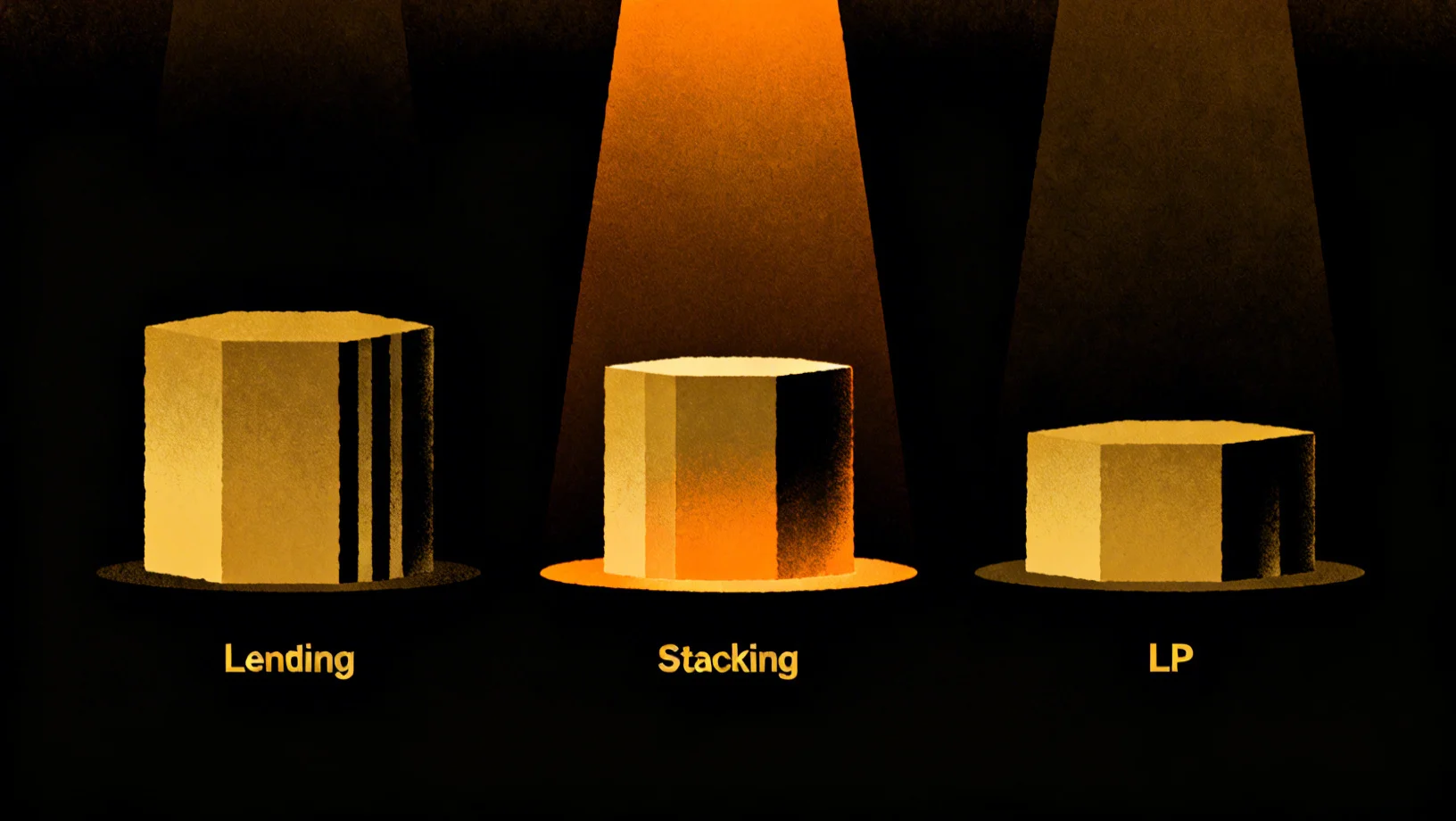
Solana Stablecoin Yield: Earn Without Touching Volatile Assets
Stablecoin lending is the most accessible entry point for most people exploring safe passive income in DeFi on Solana. The mechanics are straightforward: you deposit USDC (or USDT) into a lending protocol, the protocol lends those funds to borrowers who post collateral to access them, and you earn interest on the amount you have deposited. The key reason this is considered lower risk is that your principal is in a stablecoin. Unlike holding SOL or other volatile assets, USDC does not fluctuate significantly in price under normal conditions. Your yield fluctuates, but the asset itself holds its value, assuming the stablecoin maintains its peg (discussed more in the risks section below). Borrowing on these protocols is overcollateralized: borrowers must post more collateral than the amount they borrow. If their collateral value drops below the required threshold, the protocol automatically liquidates it to protect lenders. That mechanism is designed to protect your deposit from borrower default, and it is a meaningful structural difference from unsecured lending. Typical APY range: 5-9%, though this varies with borrowing demand. When more people want to borrow USDC, rates go up. When demand drops, rates come down. Variable APY means the 7% you see today could be 4.5% next month. This is not unique to DeFi: savings account rates move with central bank policy in exactly the same way. What you need to start: • A Solana wallet (Phantom or Backpack are commonly used options) • USDC in that wallet • Access to a Solana-based lending protocol The deposit process itself is simple: connect your wallet, select the asset you want to deposit, confirm the transaction, and your funds begin earning. Withdrawals are generally available at any time, though very high utilization rates can occasionally limit liquidity temporarily. For anyone new to this space, understanding the [key risks to understand before you deposit](/blog/risk-management/defi-yield-risks-explained) is worth doing before committing funds. This strategy aligns closely with the framing of "Solana stablecoin yield passive income" because it offers stable, predictable returns without exposure to price volatility, making it the most approachable of the three strategies for risk-averse participants.
Earn SOL Yield Without Active Trading: Liquid Staking Explained
Liquid staking is the natural choice for SOL holders who want to earn yield without selling or actively trading their position. To understand liquid staking, it helps to start with native staking. When you stake SOL directly with a validator, you are locking your tokens to help secure the Solana network. In exchange, the network distributes staking rewards, typically in the range of 7-9% APY. The tradeoff: your SOL is locked during that period. To unstake it, you initiate an unbonding process that can take several days before your tokens become available again. Liquid staking solves that tradeoff. Instead of locking your SOL, you deposit it into a liquid staking protocol, which stakes it on your behalf across a curated set of validators. In return, you receive a liquid staking token (LST): mSOL, jitoSOL, or bSOL, depending on the protocol you choose. This token represents your staked SOL and accumulates staking rewards over time. The crucial difference: you can move, trade, or exit that token at any time, unlike with native staking. The "while holding" framing matters here. You are not selling SOL. You are not speculating on a different asset. You are earning automated yield on SOL you planned to hold anyway, with the added flexibility of being able to exit without waiting through an unbonding period. Staking rewards come from two sources: protocol emissions (new SOL distributed to validators) and transaction fees collected by those validators. These are not speculative yields generated by short-term market activity. They are structural features of the Solana network, built into how the protocol distributes value to participants who help secure it. That makes liquid staking returns more predictable than most other DeFi yield sources. This strategy is particularly well-suited to the goal of earning SOL yield without active trading. You are not rebalancing. You are not timing entries and exits. You are holding a yield-bearing version of the same asset. For a clear explanation of the [difference between native and liquid staking](/blog/yield-strategies/validator-staking-vs-liquid-staking-solana), that comparison covers the tradeoffs in detail. Understanding [liquid staking tokens as yield-bearing assets](/blog/yield-strategies/yield-bearing-assets) also provides useful context before you deposit.
Automated Vaults on Solana: Hands-Off Yield, Intelligently Managed
If stablecoin lending is the simplest entry point and liquid staking is the most intuitive choice for SOL holders, automated vaults are the most genuinely hands-off option of the three. A vault is a smart contract that allocates your assets across yield strategies automatically. Depending on the vault design, it might allocate your USDC across stablecoin lending protocols to capture the most competitive rates, adjust exposure between lending and staking as market conditions shift, or manage a combination of strategies within a single deposit. All of this happens without you monitoring rates, switching protocols, or manually rebalancing your position. The defining feature of quality vaults is auto-compounding. Rather than letting your earned yield sit idle, the vault reinvests it automatically, putting your returns to work alongside your principal. Over time, this compounds meaningfully. A vault earning 8% that compounds daily will outperform a position earning 8% that you reinvest manually once a month, simply because of compounding frequency. The math favors more frequent compounding, and vaults handle that automatically. For beginners, one of the most valuable vault features is single-asset deposit. Some yield strategies require you to provide two assets in a specific ratio (a common requirement in liquidity pool strategies). Single-asset vaults let you deposit USDC or SOL and let the vault handle everything else. That removes a significant source of complexity and potential error for people new to the space. Typical APY range for automated vaults: 6-15%, depending on the vault's underlying strategy and current market conditions. That wider range reflects the fact that vaults can pursue a broader set of opportunities than any single strategy. The tradeoff is slightly more complexity in understanding what the vault is doing with your assets at any given moment. For most participants using a well-designed vault, that tradeoff is worth it. This is where the hands-off strategies framing applies most directly: once you have deposited into a vault, the strategy runs without your input. Periodic check-ins are still advisable, but the active management layer is handled by the protocol. To understand [how auto-compounding vaults work](/blog/yield-strategies/auto-compounding-vaults-explained) in more detail, that resource covers the mechanics clearly. For a broader view, [types of vault strategies available on Solana](/blog/yield-strategies/vault-strategies-defi-explained) covers the range of approaches and how they differ.
Real Risks in Low-Risk DeFi Yield (And How to Think About Them)
The word "safe" in DeFi is always relative. The strategies in this guide carry lower risk than active trading, leveraged positions, or exposure to volatile asset pairs. They do not carry zero risk. This section covers five risks worth understanding before you deposit, presented rather than alarmingly.  Smart contract risk is the baseline risk in every DeFi interaction. Protocols are written by humans, and code can contain vulnerabilities. If a protocol is exploited, deposits can be affected. Mitigation: use protocols with independent security audits and a meaningful operating track record. Avoid concentrating all your funds in a single protocol, regardless of how reputable it appears. Stablecoin depeg risk affects stablecoin lending positions. USDC is the most widely adopted stablecoin and has maintained its peg through significant market stress events. But algorithmic stablecoins have failed before, and even established stablecoins can experience brief depegs during extreme market conditions or banking stress. Mitigation: stick to major, well-collateralized stablecoins backed by regulated institutions, and stay aware of news that might affect the issuer. Liquid staking token risk applies to strategies involving mSOL, jitoSOL, or bSOL. If one of these tokens trades at a significant discount to SOL during a stress event, exiting your position may mean receiving less SOL than you deposited. This is sometimes called an LST depeg. Mitigation: understand how the exit mechanism works for your chosen protocol before depositing, and be aware that exits during high-demand periods may carry a small discount. Variable APY affects expected returns, not principal. The 7% displayed today is an estimate based on current conditions. Rates can drop significantly with changing market dynamics. This is not a loss of capital, but it affects whether the strategy meets your return expectations. Mitigation: treat any APY display as a reference range, not a fixed commitment, and evaluate the strategy over a multi-month horizon rather than a single snapshot. Protocol and governance risk covers changes made by the protocols themselves: fee increases, strategy parameter adjustments, or in rare cases, governance attacks that redirect protocol funds. Mitigation: follow the protocol's official announcements and governance forums. Prefer protocols with transparent, community-governed parameters over those with centralized admin control. A closing reframe: none of these risks are unique to DeFi. Every financial instrument carries risk. Traditional savings accounts carry bank insolvency risk. Bonds carry default and duration risk. Stocks carry market and company risk. The goal is to understand the specific risks attached to each DeFi strategy and manage them with good habits: diversification, reputable protocols, and appropriate position sizing. For a [deeper breakdown of DeFi yield risks](/blog/risk-management/defi-yield-risks-explained) and a framework for [how to evaluate risk across DeFi protocols](/blog/risk-management/defi-risk-framework), those resources offer a structured approach.
How to Start Earning Yield on Solana: A Beginner's Step-by-Step
 The gap between understanding a strategy and actually executing one is where most people stall. Here is a concrete, step-by-step path to your first deposit. 1. Set up a Solana wallet. Phantom and Backpack are both well-established options with clean interfaces designed for people at all experience levels. Once installed, write down your seed phrase and store it somewhere offline and secure. This is the most important step in the entire process: the seed phrase is your only recovery option if you lose access to your device. 2. Fund your wallet. Buy SOL or USDC on a centralized exchange (Coinbase and Kraken are common starting points for new users) and withdraw to your Solana wallet address. Double-check the address before confirming. Small network fees apply to all Solana transactions, so having a small amount of SOL in your wallet is necessary even if your primary strategy is stablecoin lending. 3. Choose your strategy. Based on the sections above: stablecoin lending is the lowest-complexity entry point for people who want to avoid price volatility; liquid staking is the most natural choice for SOL holders who want to earn while holding; and automated vaults offer the most hands-off execution for anyone who wants a single deposit to handle everything. 4. Start small. Deposit an amount you are comfortable learning with. The first experience of navigating a DeFi protocol is worth doing with a limited position: it lets you understand the interface, confirm the deposit process, and verify that withdrawals work as expected before committing a larger amount. 5. Check in periodically. Low-maintenance does not mean zero-maintenance. A monthly review is a reasonable habit: confirming that APY looks healthy, your position is intact, and no unusual protocol activity has occurred. Most strategies do not require action on your part, but staying informed is part of responsible participation. If you want the most hands-off option, Lince Smart Vaults let you deposit a single asset (USDC or SOL) and automatically allocate it across yield strategies without managing pairs, monitoring rates, or rebalancing manually. It is designed for exactly this use case: earning automated yield on Solana without becoming a full-time DeFi participant. For context on what makes these yield sources sustainable over time, [understanding what makes DeFi yield sustainable long-term](/blog/yield-strategies/yield-sustainability-defi) is a useful read before you commit to a strategy.
Frequently Asked Questions
### Is earning yield on Solana DeFi safe for beginners? Stablecoin lending and liquid staking are among the lower-risk options in DeFi: they avoid leverage and price speculation. They are not risk-free (smart contract and depeg risk remain), but they are significantly less complex than active trading strategies. Beginners should start with a small amount to learn the mechanics before scaling up. ### What is a realistic APY for safe Solana DeFi strategies? Stablecoin lending typically yields 5-9%, liquid staking SOL around 7-9%, and automated vaults 6-15% depending on the strategy and market conditions. These rates are variable and fluctuate with demand. Treat any APY figure as an estimate and a reference range, not a guaranteed return. ### Do I need to monitor my DeFi positions every day? With low-maintenance strategies like stablecoin lending, liquid staking, or automated vaults, daily monitoring is not necessary. A monthly check-in is a reasonable habit: verifying that rates look healthy, your position is intact, and no unusual protocol activity has occurred. ### What is the difference between staking and liquid staking on Solana? Native staking locks your SOL for a set period, during which you cannot move or use it. Liquid staking gives you a token (such as mSOL or jitoSOL) representing your staked SOL that you can move or use in other DeFi protocols, offering more flexibility at a similar yield level. ### Can I lose money with stablecoin yield strategies? Your principal in stablecoins does not face price volatility the way SOL does, but losses are still possible if the stablecoin depegs, the lending protocol has a smart contract exploit, or the platform is otherwise compromised. These risks are low with established, audited protocols but are real and should factor into your decision. ### How much do I need to get started with Solana DeFi yield? There is no strict minimum for most Solana DeFi protocols. In practice, you will want enough to cover small network fees on each transaction plus whatever amount you plan to deposit. Many people start with a modest sum to test a strategy and gain confidence in the mechanics before committing more. Solana's low network fees make small starting positions more practical here than on higher-fee chains. ### What happens to my yield if Solana network activity drops sharply? Staking rewards are relatively stable because they come from protocol emissions and are distributed regardless of daily activity levels. Stablecoin lending rates, however, are tied to borrowing demand and can drop when activity is low. Automated vaults adjust allocations in response to changing conditions, which helps smooth out some of that variability over time.